Showing posts with label patent medicine. Show all posts

Tuesday, January 22, 2013

Victoria Dinnick takes Dumpdiggers on a Tour of Gadabout on 19th January 2013

Gadabout Vintage at 1300 Queen St E is owned and operated by Victoria Dinnick, who gave Dumpdiggers a walking tour of her famous antiques store on 19th January 2013.

Inside this front cabinet there are about four hundred small items for sale. There are cameo broaches, fake gems and other glass baubles, hair accessories, vintage belt buckles, old coins, antique watches, war medals, silver whistles and odd bits of gold coloured jewelry.

Most Toronto antique collectors probably already know Gadabout, and have met its owner. That's because Victoria Dinnick makes herself known wherever she goes - she's a powerful smart lady with a dry sense of humour that leans toward sarcasm.  Victoria is a familiar face in the crowd at auctions and estate sales all over Ontario and Quebec. She regularly participates in the seasonal shows of several antiques and collectibles subcultures including The Old Paper Show, and The Old Clothing Show.

Victoria was a fixture at Harbourfront Antique Mall in the 1990s and still has regular customers that seek her out at sales and make frequent visits to her 1300 Queen St E address. There are some pickers from whom she still buys merchandise, and veteran collectors to whom she sells stuff.  Anyone can email the store Info @ GadaboutVintage. com

Victoria Dinnick started collecting antiques in the 1980s and by the early 90s she was selling her merchandise at Harbourfront Antique Mall, which, if you don't know was a giant two story antiques superstore here in Toronto - it had twenty or more independent dealers under one roof and was located near the base of Spadina at Queens Quay, right on the lake shore near what was once Ree's Wharf ...

Victoria escaped Harbourfront and opened Gadabout, her first antiques and collectibles store in 1997, in the Mirvish Village on Markham and Bloor. She moved to 1300 Queen St East in 1999 and was instrumental in the gentrification of this area which now boast several antique furniture stores, funky cafes, used clothing stores and specialty coffee shops.

Victoria told me there are over 100,000 individually priced antiques and collectibles inside Gadabout - the building is packed full of old stuff for sale, and the prices are 

A curious helper holds a larger then life sized poster of a man frozen in the unmistakable action of putting on his coat.  This young helper with a boy's name watched me walk about the rows of shoes and bags and past racks of coats and reminded me once that all the clothes for sale in Gadabout have been previously dry cleaned.

Victoria Dinnick and her dog ...


Gadabout medicine cabinet shelf has lots of turn-of-the-century patent medicine quackery and many dozen old remedies including morphine pills and other opiates, and lots of bizarre wild concoctions. At a glance I spotted the blue coffin poison which is an item that I know and more importantly I know approx what it's worth and can use it as a handy measure by which to gauge Gadabout prices.


Victoria stunned me by only asking $99 for this gorgeous large UK cobalt blue coffin poison!

Here is liquid dextrose, a sugary syrup for intravenous feeding in hospitals. 

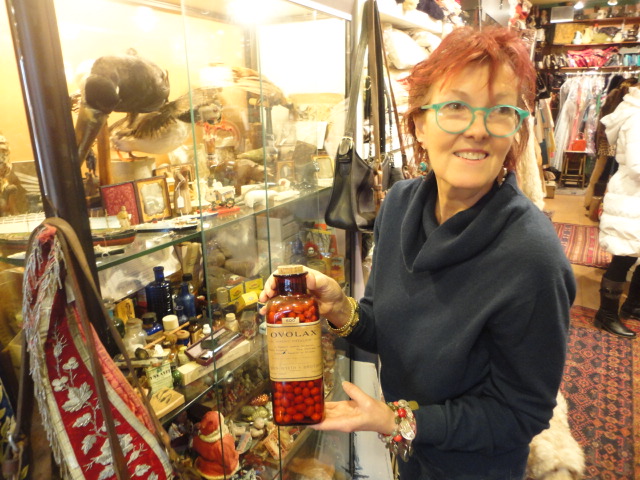
Lots of the medicines in the cabinet are full of their original contents. Here is Ovolax which is a healthy laxative prepared by John Wyeth & Brother from Chicago. These guys went on to found a huge drug company - see here for more on Wyeth Co


From Germany, here is a cardboard container filled with 100 Red Pearls whcih were taken as a remedy against anxiety and nerves. Yes the red pearls are filled with opiates and this little package is sure to be worth a small fortune today, but Victoria is asking only $35 for the item. * She could triple that on eBay I reckon.


The show continued and got even better when she found a bright red wallet that contained medicated gelatin 'lamels' which are strips of morphine infused cloth that act as a local anesthetic? I suppose. This is military grade pain killer for front line soldiers in WW1. The writing is as follows,  MEDICATED GELATINE LAMELS. SAVORY & MOORE, LTD, LONDON / EACH SHEET IS DIVIDED INTO 24 SMALL SQUARES. EACH SMALL SQUARE IS AN ORDINARY DOSE


 Look inside and you can see what's left of the strips.


Finally Victoria is very eager to promote her latest discovery - a 1929 Map of Toronto !

Although faint with age, the map is good condition has been professionally restored - its linen backed and has been recently cleaned and repaired. 


Victoria is asking $875.00 for the 1929 Map of Toronto with street index.

Evening in Paris


Gadabout is located at 1300 Queen Street East Toronto, ON M4L 1C4‎  (416) 463-1254
Antique Store, Clothing Store - open most days from 11:30 am - 6:30 pm

It's a good destination for the intrepid shopper who likes the hunt as much as the find!

Thursday, December 16, 2010

Lost Creek under Toronto's Streetcar Condos

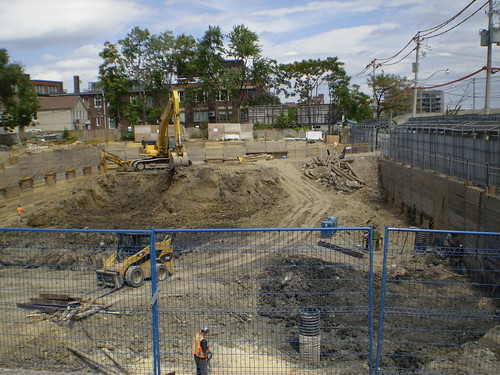
While excavating the property at 510 King St East in Toronto, workers discovered a lost creek which was heaped with trash - some of which is now treasure.
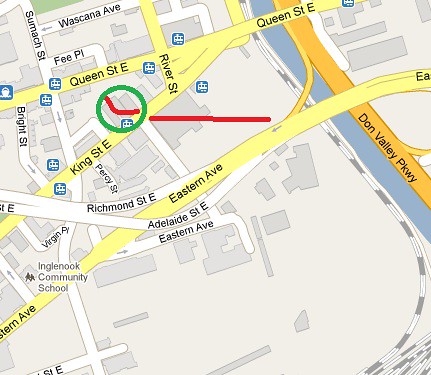
Recently Dumpdiggers admin were treated to a fascinating account of valuable antique glass bottles and early Canadian pottery being recovered from construction site in downtown Toronto. The building project at 512 King St E is owned by a hip property developer called Streetcar. The site is located on the north side of King St. at River St which almost as far east on King as you can go – its opposite St Lawrence street which is the north western extremity of the massive River City condominium development.

By comparison, the relatively small 'Streetcar condos' building project on the north side of King St is well under way, and will probably be completed by the summer of 2011. But back when this property was still being excavated, in July 2010, the developers found plenty of evidence of a small creek that ran above ground here, up until the early 1880s. This creek was yet another tributary of the mighty Don River that was buried by man before the turn of the century.

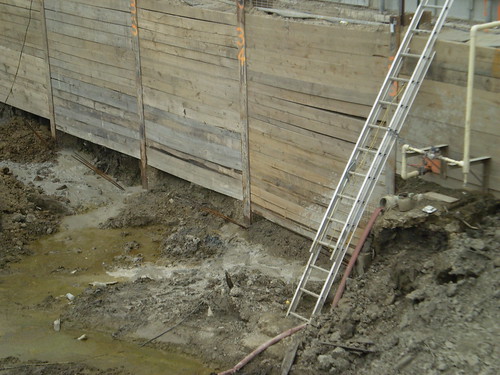
Evidence of a lost creek under Toronto


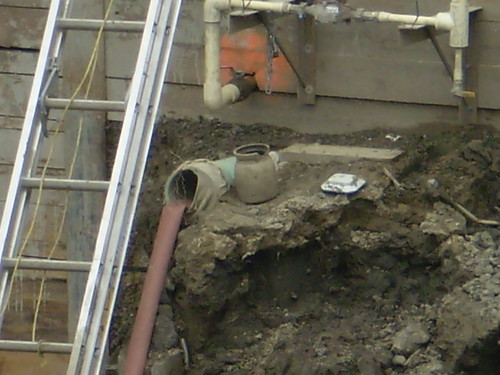
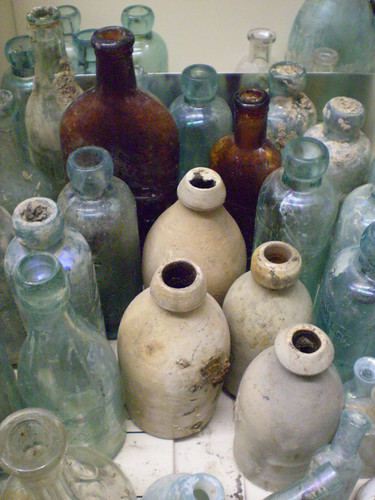
The old glass jars and cream coloured stoneware beers floating on the top of the puddle at the bottom of the excavation are all that remains of a centuries old dump site that served industrial age Toronto. You can see the water is being sucked out of the hole by sump pumps. When these photos were taken, the spring water was drained into the storm sewers on the south side of the property and bottles were popping up all over the place.

evidence of a lost creek under 510 King St Toronto
The construction site manager was very helpful and accommodating, and was himself an expert in the history of the site. He shied away from my camera of course; posing for pictures on a job site can be risky. But to his credit, he was very forthcoming with good information. ‘The creek has no name' he said in provocative tone, and his words echo in my thoughts.


While pointing outside from behind his comfortable desk in the heated office trailer, he told me how the north facing wall of the excavation, and now the building's foundation is engineered with specific water collecting apparatus to channel the accumulation into nearby municipal storm sewers.

early Canadian glass bottles
A good storyteller, the construction site manager recounted the hot July days when the backhoe operator dredged out several tones of metal debris that had been dumped and incinerated over a hundred years ago. Back then the natural water system was deliberately buried under the heaviest man-made materials available; industrial age iron scraps, building stones, broken bricks and cement was dumped here to suffocate the spring. The refuse also contained wagon loads of hundred year old household trash. The rubbish was incinerated in keeping with period legislation about dump maintenance with respect to hygiene, so only the strongest, luckiest bottles survived.

Q.S GRAINGER HOTEL KEEPER TORONTO CANADA 1880 BEER BOTTLE
Q.S GRAINGER beer bottle, Toronto hotel keeper, 1880
The Dumpdiggers reader who contributed information to this story reported that this Q.S Grainger stoneware beer bottle came from this dig site. It was hand-turned on a pottery wheel by an unknown local potter in the 1880s. There are only a few remaining with this stamp, and every specimen is unique. He also wrote that, "There was an assortment of Toronto blob top pint & quart soda water bottles, many medicine bottles from Canada & USA, glass & stoneware, ink bottles, stoneware jars & pottery items. There was even one amber & one aqua glass fire grenade bottles! A few pot lids from the UK. A total of about 300 blown bottles that date from 1870 to 1905. This lot had a creek running from north to south of the property and it was filled in through many years with ashes. Mixed in the ash were numerous bottles. The workers only picked up the embossed bottles that were worth money and left the unembossed ones that were not worth someones time to clean."

Origins of the lost creek and its path to the Don River,
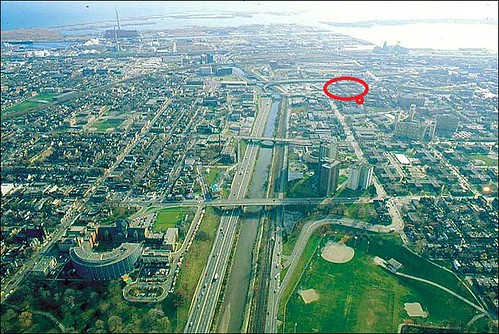
The lost creek originates from a natural spring just north of the excavation site. In the 1880s it was on the surface and ran south through this property and what is now the River City condo developments property, the future site of the Pan American games in 2014.


The lost creek fed into the Don River.

The Don River Straightening Project helped Toronto become a better city, but it also created rich pockets of good historic trash for Toronto diggers to unearth for centuries to come. Let me tell you a story about the Don River in Toronto in the late 1800s. The people of this great city have had a love / hate relationship with the Don since the origins of the British settlement in the 1790s. straight Don River in TorontoOne hundred years later, desperate to stop the flooding, and to provide a shipping channel and to create additional industrial land near the lake, a vast scheme known as "the Don Improvement" was carried out in Toronto. The project straightened the river south of Gerrard St to make room on either side for railroads, roads and other urban infrastructure. Ashbridge's Marsh was drained and filled, eliminating a public health concern, while providing acres of new industrial land in the Port Lands. The expansion of the city in the early 1900 buried the last traces of the creek that once ran across 512 and 510 King St East.

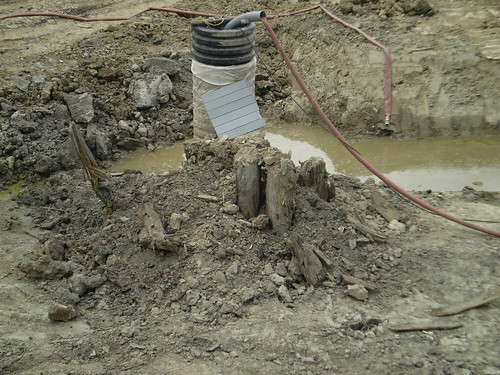
Are these posts the remnants of a small bridge?

As you can see, wooden posts were visible at the bottom of the hole. Let me remind you that the bottom of the hole was almost ten feet below the surface of present day King St East. Were these wooden posts part of a small bridge across the lost creek? Picture that if you can, and its easy to see residents walking and talking... No doubt some of the antique glass soda bottles were discarded by the users themselves immediately after consuming the contents. Soda bottles are exactly the kind of rubbish that get's pitched by hand, while the milk bottles and medicines are more typical of a systematic municipal trash disposal program at the site.

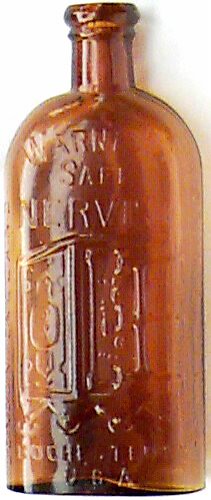
One of the best bottles that was recovered was this amber Warner's Safe Cure which was a popular patent medicine. Because it has the names of three cities embossed in the glass, its what's known today as a 3 city Safe Cure.

3 CITY NERVINE 1/2 PINT 1889
WARNER’S ~ SAFE ~ NERVINE ~ LONDON - ENGLAND (LEFT SIDE) TORONTO - CANADA (RIGHT SIDE)~ ROCHESTER ~ N.Y. U.S.A. HALF PINT, AMBER, DC. This bottle's value is approximately $500 as per the Werner's Reference Guide blogspot. The website is definitely worth perusing if you have any Warner bottles in your collection.

Another excellent source of information on Warner Patent Medicine bottles is the Warner's Safe Cure Blog which is the product of a skilled writer that lives his passion for this specific type of antique glass. I've just spent three hours reading sixty posts on his site.