Showing posts with label Toronto. Show all posts

Monday, April 23, 2018

2018 Toronto Bottle Show


Toronto Bottle Show & Sale hosted by the Four Seasons Bottle Collectors Club was held at the Pickering Recreation Complex again, and once again this year the show was really well attended by the public...

This year's story, on Sharing Toronto magazine, does not include these lovely images as some part of the story , their dealer, the circumstances are lost. Click the pics - they expand


A couple of KUNTZ LAGER BEER s.

This one from Scott Jordan's table i got when i set my camera on his acrylic display cube. These medical powder cans were on top.  My camera tried to find WiFi a few seconds later..

I will probably use this Jamaican ginger essence bottle (also property of Scott Jordan) image - this is an example of a picture for which i extended nohope when I snapped it without flash,  and that usually means a slow shutter speed and blur . . .
But it came out crisp.

This is Scott Wallace's ink table - pics expand

a random stoneware ginger beer bottle offering

Marcus Johnson's Devon Mead

This year the booth by booth account of the 2018 Toronto Bottle Show appears on SharingToronto.com

Its a slow load today.. be patient.
http://www.sharingtoronto.com/2018/04/23/2018-toronto-bottle-show/

Sunday, July 12, 2015

Abel is selling some historic Toronto bottles on eBay

http://www.ebay.com/itm/James-Walsh-Co-124-Berkeley-St-Toronto-Ca-Hamilton-Torpedo-Soda-Water-Bottle-/201383978288?ssPageName=STRK:MESE:IT

Above is a link to Abel's antique bottle sale on eBay which may only be active for a few days longer (has it already ended?), at which point I will delete it and just keep the pictures here.  I do this as a service to all bottle collectors and the Canadian bottle collecting community in particular. I'm also helping Abel who has been very helpful to me.

I think the sales have already ended but its worth getting a second look at these gorgeous bottles,
 

G.S. (George Stephen) Ross Toronto C.W. (Canada West) Soda Water Torpedo Bottle
Click this thumbnail picture to visit the eBay sale and see the rest of the pictures and the history.
G.S. (George Stephen) Ross Toronto C.W. (Canada West) Soda Water Torpedo Bottle 

US $2,500.00
( 201380328119 )
yorkginger2111Feedback percentage of100%


James Walsh & Co. 124 Berkeley St. Toronto Ca Hamilton Torpedo Soda Water Bottle
click the link to visit the eBay sale (ended) and to see all the associated images

James Walsh & Co. 124 Berkeley St. Toronto Ca Hamilton Torpedo Soda Water Bottle
US $750.00
1 bids
US $1,000.00
Buy It Now
T


This Auction Sale is For One Rare (James) Walsh & Co. 124 Berkeley St. Toronto Ontario Canada Torpedo Soda Water 1859-1876 Bottle Only! This Great Torpedo Bottle is From The Collection of The Late Dr. R. Dean Axelson. A Museum Quality (James) Walsh & Co. 124 Berkeley St. Toronto Torpedo Soda Water Bottle is Listed For $1,000.00 in His 2007 Price Guide. This Bottle is in Mint Condition With no Cracks, no Chips, no Case-ware, no Scratches or Restorations.
more

Friday, June 26, 2015

Glassblowing with Eric Davy, Funerary Glass Artist in Toronto

Thursday 23rd of June 2015, Dumpdiggers watched Eric Davy Funerary Glass Artist make a custom glass funeral urn in the glassblowers' studio at the base of the Mississauga Living Arts Center while researching an article for Digital Journal, on how cheaper cremation services increases demand for funerary glass, which hypothesizes that art glass consumption is rising in Ontario and all across Canada because cremation costs are falling and people have more money to properly honour their dead.

The funeral industry is in flux, and custom glass urns made specifically to contain cremated ashes are an increasingly popular alternative to buying a remote cemetery plots as a final resting place for deceased family members.

Hot glass artists are thriving in conditions brought about by innovative funeral service directories and the growth of online companies like Basic Funerals with cremation services which dramatically cut costs and impart a willingness on family members to do more to honour their dead relative.

Not only do bereaved families have extra money in their pockets, I reckon they also feel a greater obligation to commission something to commemorate a great life lived, and a make some form of lasting monument to the person they wish to remember.

This is Good News for Glassblowers Making Funerary Glass in Ontario 

Eric Davy started with a hot glass bud on a pipe that he got from a nearby kilm.  He got this colour block - a bullet of hot glass that's pure white in colour that will be blown up to become the white inner coating of the from a small kiln at the side of the studio.


A piece begins when the glass blower reaches inside the furnace and into the crucible that is filled with clear, melted glass and “gathers” a layer of molten glass on the end of a steel blow pipe.

The glass blowing studio is a very hot place to work - there are two furnaces active and two furnaces waiting to be charged with glass and propane on the other side of the room. At peak operation, all four pieces of equipment could be red hot and making the blowers sweat, even in the wintertime.
Eric rolls the gather on the marver - the steel table that has been swept clean expressly for this purpose.

Eric keeps the piece hot and malleable by subjecting the glass to very hot temperatures inside the “Glory Hole” which is where the glassblower shapes his or her work.
The glass is then heated in the glory hole – all the while the artist is turning the blow pipe and keeping it in constant motion. I imagine this is much like honey on a honey-dripper stick, except much less viscous.

Anyway skipping along its safe to say there are a great many trips back and forth from the steel marver to the Glory Hole because the glass needs to be kept above 1000⁰ F. and Eric knows approximately how much glass he needs to get on the pipe, and what shape the blob needs to be in before he can begin colouring the glass.

Adding colour to art glass, Eric selects blue and red base colours and instructs his assistant Alex to lay out the glass powder on the marver table.  She spreads two rows of colour, red and blue, one right above the other.


Various forms of colored glass powders, frits and bars are used to create varied patterns and designs in the piece. Once the piece has been formed into a diamond shaped cone to Eric's satisfaction, he rolls the red hot glass on the pipe over the color, picking up pieces with each roll.


And then again he walks back to the Glory Hole where the colored glass is heated to melt into the clear glass. Again, Eric keeps turning the pipe to keep up the constant motion and keep the symmetry of the glass shape as the colour powder melts.
 
Eric sits and rests the pipe on the steel “arms” of the bench and turns it with one hand. With the other hand the artist uses tools such as cherry wood blocks, wet newspaper, wooden paddles and tools made of stainless steel.


This process requires Eric to have perfect coordination between right and left hands. The artist may be shaping a round piece, an oval, or intend to make a wide open plate or bowl.  In this case Eric is making a funeral urn and sitting at the bench is where Eric determines how to make the glass blob assume the shape in he desires in his mind. The process of heating and turning the blob in the Glory Hole and shaping at the bench will be repeated many times.

Applying Gold Foil to the Funeral Urn For Decoration

One of Eric Davy's signature colouring rituals is to roll the red hot glass in gold foil which of course melts into the surface and imparts a fantastic finish in the blown piece. Alex Wilson lays out gold foil in a special cabinet and Eric Davy rolls the glass on 4 inch strips of foil on both sides.

 
Blowing into the Pipe - once the piece has been coloured, the actual glass blowing begins.


It starts with a puff on the end of the blow pipe to create a bubble. Then it’s back to the Glory Hole for more heating and turning. And back to the bench for more shaping. This cycle gets repeated many times, depending on the size and shape desired by the artist. Already Eric can see the gold foil has melted and new wonderful colours are manifesting on the surface of the bubble.

Transferring the Project to the Punty. Once the glass bubble shape is satisfactory, the piece has to be transferred to a “punty” – another steel pipe that’s been heating over flames. Alex Wilson takes the punty and affixes a small 'gather' of clear glass from the furnace. As Eric Davy stops turning the piece, Alex attaches the hot punty with the molten glass to the other end of the piece

Moving the piece from the blow pipe to the punty will make it possible for Eric to create the opening of the funeral urn. The punty will be attached to what will become the bottom of the piece.

At exactly the right moment, Eric “raps” the blow pipe and it breaks away, leaving the piece attached to the Punty. This is a tricky step in the process Eric warns, and although he makes it look easy, sometimes this transfer results in the molten glass bubble tumbling off the rod and the pipe and smushing on the floor.

Eric uses giant scissors to open up urn. The interior of the urn is a creamy white which is the colour block that was shaped into a bullet in the Glory Hole before the first gather at the very beginning of the process.

Eric returns to the bench and uses a variety of tools to create the mouth of a vase or to open up a vessel. He will use the heat in the Glory Hole to continue to make changes in the shape of the piece while using other tools at the bench.


Once Eric is satisfied with what will be the final product, it’s time to remove the piece from the punty.

Another difficult part of the birthing process, Eric once again relies on his training and years of experience to know exactly how and when and how hard to hit the punty so that the finished piece drops to a soft landing on a towel on a nearby table.

Alex Wilson gets busy with a blow torch making the bottom of the urn - erasing the pontil mark and accentuating the kick-up so the urn sits perfectly flat on its circular base. Next the item is placed hot into the annealer.

The annealer is an oven that keeps pipes and punties hot, and can be used to slowly cool down Eric's finished work to avoid cracking and any breakage that can happen as the different coloured glass cools at different rates. This is especially true when making Memory Glass with a foreign substance like bone ashes as Fuel Ghoul : Science of Making Memory Glass reports on Typepad.

Alex Wilson, Eric's assistant  artist picks up the scorching-hot piece using Kevlar gloves,  and quickly transfers it to an annealing oven. This oven is kept at 960⁰F and then cooled down over a period of 14 hours to room temperature. This slow cooling down is to prevent the piece from cracking or breaking.

This is a picture of a finished piece that I used in my article on Digital Journal.

Monday, March 18, 2013

Toronto Basement Waterproofing Company Finds Privy Pits Loaded With Antique Glass Bottles

When downtown Toronto was growing up in the late 1800s, the engineers buried all the little creeks and streams that used to course across the land.  They just filled them in with whatever was handy, and quite often that was garbage - two dozen wagon loads of smelly household trash could be easily diverted from regular pickup to fill a ravine and plug up a creek on the outskirts of town. Finding those plugs is what keeps Dumpdiggers awake at night...

I did a story on a Lost Creek in Toronto and showed how property developers removed rusty metal and glass from the bottom of their excavation at King and St. Lawrence, and how they unlocked a small stream that soon made a large pond on the bottom of the pit. The condo building that exists there today has installed permanent pumps to drain the water away from the north wall and into the storm sewers on the south side of the property.

To the right is a detail from P.A. Gross' Lithographic Bird's Eye View of Toronto (1876), showing Garrison Creek a decade before it was buried by urban developers. 

Garrison Creek is a famous example of a water system that was forced underground, and you can see here on Vanishing Point Garrison Creek history website that it runs inside a brick lined sewer tunnel under or near the basements of hundreds of homes and under two dozen streets, all the way from its origins near Lawrence and Weston Rd, down old Keele, down through the College and Dufferin area, all the way down to Lake Ontario.

Basement Waterproofing Contractors Thrive in Toronto's Garrison Creek Flood Plane

The water flow in the city is much different now than it was when creeks were on the surface of the land. Today the autumn rain and melting snow in the spring seems to find little pockets of houses where it floods basements. A reputable basement waterproofing contractor in Toronto can make a killing in the Garrison Creek flood plane.
 
Right up until the 1970s Canadian home builders really didn’t have the technology or available products to offer a cost effective basement waterproofing solution. The best  home builders did some 'damp proofing', and Victorian era landscape architects are famous for making drainage contours and berms to avert a flash flood water courses, but basement waterproofing was heretofore unknown.

Today the accepted practice is to dig trenches and drain the excess moisture away from the cement walls from the outside using specially perforated plastic pipe that has capacity to rapidly drain the water from soil.

The basement waterproofing contractor has a hard job that is filled with back breaking labour, because he or she is usually digging so close to the walls of the structure the work really cannot be mechanized to any great extent. However this discomfort is quite often remedied by numerous discoveries of coins and small bottles and many other valuable things that accumulate near walls over the years.

Coins are commonly found when digging foundation walls at the sides of houses and barns. That’s because the wall has been there for a long time and it has always been handy for leaning against or even sitting up against in any season, and inverted pockets dump coins. Ask any archeologists and they will tell you that they find coins on both sides of any wall with equal frequency.

Bottles are uncovered in privy pits dug below latrines which once existed up against the side of the house. Before there was indoor plumbing, whole families used outdoor facilities and these holes were also the most commonly used trash receptacle for nonburnable refuse like old bottles, broken stoneware crocks, porcelain dolls, tools and dead pets.

Here's the excavation team showing off their best finds to the homeowner - they were uncovering bottles that were discarded over a hundred years ago.

These guys don't know they're digging out a pioneer family's privy pits, but not that it matters much, as that was over a hundred years ago and the chemical structure of the soil around the bottles has changed as much as the structures on top of the land above.

Post by on Mar 18, 2013

Tuesday, January 22, 2013

Victoria Dinnick takes Dumpdiggers on a Tour of Gadabout on 19th January 2013

Gadabout Vintage at 1300 Queen St E is owned and operated by Victoria Dinnick, who gave Dumpdiggers a walking tour of her famous antiques store on 19th January 2013.

Inside this front cabinet there are about four hundred small items for sale. There are cameo broaches, fake gems and other glass baubles, hair accessories, vintage belt buckles, old coins, antique watches, war medals, silver whistles and odd bits of gold coloured jewelry.

Most Toronto antique collectors probably already know Gadabout, and have met its owner. That's because Victoria Dinnick makes herself known wherever she goes - she's a powerful smart lady with a dry sense of humour that leans toward sarcasm.  Victoria is a familiar face in the crowd at auctions and estate sales all over Ontario and Quebec. She regularly participates in the seasonal shows of several antiques and collectibles subcultures including The Old Paper Show, and The Old Clothing Show.

Victoria was a fixture at Harbourfront Antique Mall in the 1990s and still has regular customers that seek her out at sales and make frequent visits to her 1300 Queen St E address. There are some pickers from whom she still buys merchandise, and veteran collectors to whom she sells stuff.  Anyone can email the store Info @ GadaboutVintage. com

Victoria Dinnick started collecting antiques in the 1980s and by the early 90s she was selling her merchandise at Harbourfront Antique Mall, which, if you don't know was a giant two story antiques superstore here in Toronto - it had twenty or more independent dealers under one roof and was located near the base of Spadina at Queens Quay, right on the lake shore near what was once Ree's Wharf ...

Victoria escaped Harbourfront and opened Gadabout, her first antiques and collectibles store in 1997, in the Mirvish Village on Markham and Bloor. She moved to 1300 Queen St East in 1999 and was instrumental in the gentrification of this area which now boast several antique furniture stores, funky cafes, used clothing stores and specialty coffee shops.

Victoria told me there are over 100,000 individually priced antiques and collectibles inside Gadabout - the building is packed full of old stuff for sale, and the prices are 

A curious helper holds a larger then life sized poster of a man frozen in the unmistakable action of putting on his coat.  This young helper with a boy's name watched me walk about the rows of shoes and bags and past racks of coats and reminded me once that all the clothes for sale in Gadabout have been previously dry cleaned.

Victoria Dinnick and her dog ...


Gadabout medicine cabinet shelf has lots of turn-of-the-century patent medicine quackery and many dozen old remedies including morphine pills and other opiates, and lots of bizarre wild concoctions. At a glance I spotted the blue coffin poison which is an item that I know and more importantly I know approx what it's worth and can use it as a handy measure by which to gauge Gadabout prices.


Victoria stunned me by only asking $99 for this gorgeous large UK cobalt blue coffin poison!

Here is liquid dextrose, a sugary syrup for intravenous feeding in hospitals. 

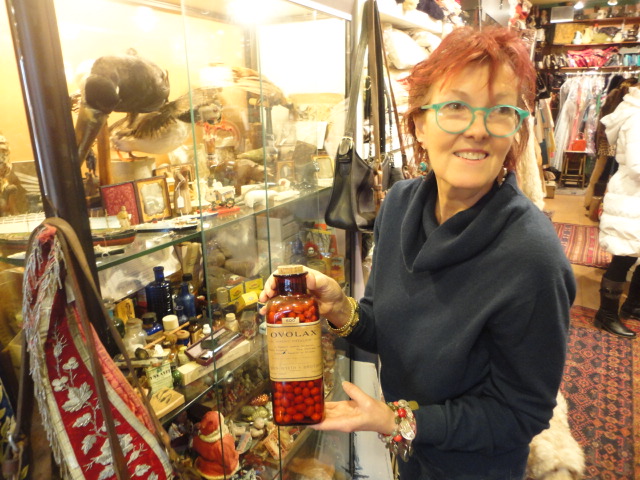
Lots of the medicines in the cabinet are full of their original contents. Here is Ovolax which is a healthy laxative prepared by John Wyeth & Brother from Chicago. These guys went on to found a huge drug company - see here for more on Wyeth Co


From Germany, here is a cardboard container filled with 100 Red Pearls whcih were taken as a remedy against anxiety and nerves. Yes the red pearls are filled with opiates and this little package is sure to be worth a small fortune today, but Victoria is asking only $35 for the item. * She could triple that on eBay I reckon.


The show continued and got even better when she found a bright red wallet that contained medicated gelatin 'lamels' which are strips of morphine infused cloth that act as a local anesthetic? I suppose. This is military grade pain killer for front line soldiers in WW1. The writing is as follows,  MEDICATED GELATINE LAMELS. SAVORY & MOORE, LTD, LONDON / EACH SHEET IS DIVIDED INTO 24 SMALL SQUARES. EACH SMALL SQUARE IS AN ORDINARY DOSE


 Look inside and you can see what's left of the strips.


Finally Victoria is very eager to promote her latest discovery - a 1929 Map of Toronto !

Although faint with age, the map is good condition has been professionally restored - its linen backed and has been recently cleaned and repaired. 


Victoria is asking $875.00 for the 1929 Map of Toronto with street index.

Evening in Paris


Gadabout is located at 1300 Queen Street East Toronto, ON M4L 1C4‎  (416) 463-1254
Antique Store, Clothing Store - open most days from 11:30 am - 6:30 pm

It's a good destination for the intrepid shopper who likes the hunt as much as the find!