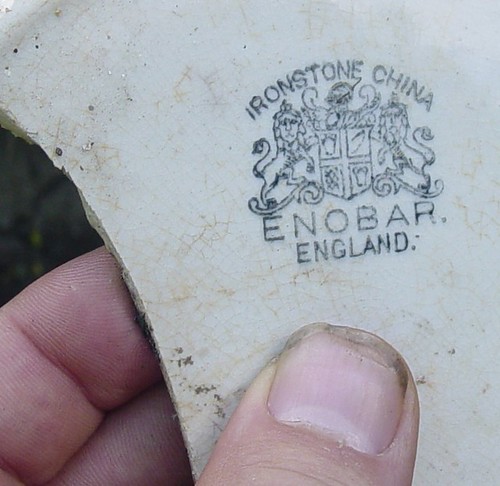
On Sunday November 18th, Roberrific and Timbits shared a hole with the Ace of Spades in his secret spot in the swamp south of Meaford, Ontario. Together, the treasure hunting trio traveled back in time to the early nineteen hundreds when the town was young and important. Less than fifty years old in 1919, Meaford was already the second most valuable steamer port on Georgian Bay. It had hotels and liveries, and five huge lumber mills. The town's population in 1919 was already 3,100 people, and it’s not much bigger today.
Our gang worked tirelessly all morning and afternoon, digging through ten feet of dump that was approximately seven feet deep with a clay bottom. We hit the bottom early on, as is the practice of the Dumpdiggers to dig as deep as hole as possible, and then fork your way up in one direction. The cardinal rule is to pick one path and stick to it – never move the dump twice.
The bottom three feet of our seven foot hole was absolutely stuffed with as many as five different layers of dump. One particular strata of brown ash yielded the best and most expensive household relics. This is where a local embossed amber medicine was found.
 Finding the distinctive brown ash on your shovel was cause for cheer – it came to signify the imminent discovery of a rich goody vein filled with all manner of assorted 1920’s hackers – and this is the layer in which we hoped to find a bumpy cobalt blue ‘Not To Be Taken’ coffin poison bottles, or perhaps a Shuttleworth poison? Or maybe even a skull and crossbones Iodine, or even an amber Hertz with a heart in the glass? No. Instead we found…
A POCKET FULL OF HACKERS suddenly appeared in the bottom third of the dump. Hackers? You know what I mean - there were lots of square amber whiskey flasks with amber glass stoppers, and clear glass or aqua columned medicines, always blank. There were a dozen cork top Listerine, Castoria, and Certo bottles, and two screw top cobalt blue Milk of Magnesia in the quart size, and at least seven green wine bottles, two champagne beer bottles, and a funky shaped green mineral water, all without embossing. Sealer jars – three of them, two Crown and one Gem which I kept.
Ace’s antique bottle mine has lots of rusty iron relics too, like saw blades, square rusty railroad spikes, spools, broken metal files, hinges and hooks. A sifter might have yielded many more interesting smaller prizes. But the ground was clumpy, and would have demanded a dedicated ‘sifter station’.
Timbits forked out a hand blown antique light bulb and checked it for Thomas Edison’s early brand signature which he says appears on the company’s early light bulbs. This bulb was as big as his hand, and black on the open end where the base had corroded away and discolored the glass.
LIKE BURROWING RODENTS we tunneled for treasure. Perhaps I should explain to anyone that’s never harvested a dump, or seen a documentary on television, or read a really good blog, just exactly how bottle diggers move through a site. There’s a method in their madness, and it’s their determination to get to the very bottom of the deposit as quickly as possible that helps preserve their prizes… let me explain.
Inside the digging process there are three sub-processes; 1 sinking the shaft, 2 forking the sides, 3 cleaning the hole. In this manner the Dumpdiggers are not really diggers at all – they are burrowers. The burrowing described above continues with bottles and relics being found in all stages, but the bulk of the booty is discovered inside the forking portion of the cycle.
 Personally, I don’t like forking the hole. I don’t care for the shoulder strain of the exercise, nor do I like the responsibility of being the first to spot and successfully ‘fork out’ valuable glass bottles without breaking them.
After a while my mind aches from repeatedly puzzling over so many promising shards. The shoulders and spouts of so many worthless specimens demand dumpdiggers’ discipline and commitment; only after each piece has been removed and examined can the senior Dumpdigger dismiss it as junk.
As diggers exercise their bodies physically, they are also at the same time bending their eyes and ears and ‘listening with their shovels’ to find clues that could lead to collectibles. The best diggers don’t break anything.
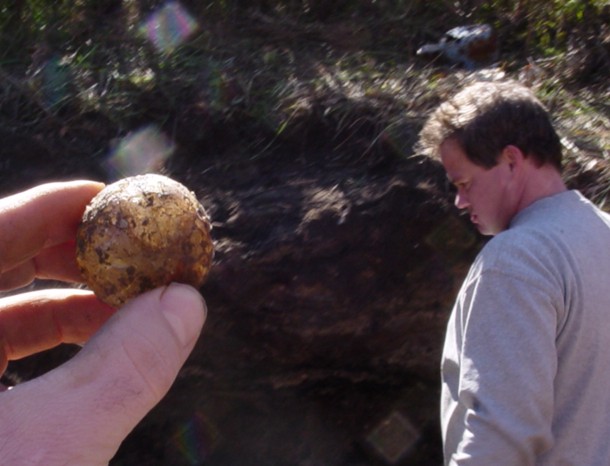
 Usually rather quiet and reserved when digging, Tim was suddenly vocal and cried out ‘Whoa!’ when he saw it – an orange glass marble rolled down across his shovel and disappeared back into the darkness. Tim scooped away the soil looking for the sphere. He knew if he didn’t secure it now, he might never see it again and it was two or three small scoops down and running fast when Tim trapped it on his shovel. But of course it too was an absolute hacker. Made around 1912, it was fashioned from clear glass and was in very rough shape – the surface looked corroded as if the glass itself has been eaten away by acid.
Tim held up the marble to look for its seams, which were hard to find. ‘To bad its junk’ he declared as he threw it up to me. The marble was indeed in terrible condition – it was so badly hacked up the seam was invisible. Was it damaged before or after it was discarded? Its very presence here made me wonder about its origins and method of manufacture? Was this marble a ‘Queenie’ or a ‘knuckler’ in some child’s game in Meaford 1919?
 As Timbits and the Ace of Spades discussed their favourite species of collectible marbles, their conversation listed green and black clambroth, rainbow colored onion skin, ribbon core, swirl and divided swirl as being the most coveted glass pieces. Tim seeks suphides in which statues of elephants, horses and Trojan warriors sometimes appear, right inside the glass sphere. According to Tim, the oldest marbles ever found were round semi-precious stones that were buried with an Egyptian child at Nagada in approx 3000 BC.
Most of the marbles used by children in late medieval times were made of fired clay. By 1600AD some water-powered stone mills in Germany were producing small polished spheres made from the local marble and alabaster that was quarried nearby. The regions near Coburg and Oberstein gave birth to the word ‘marble’ which is derived from the German term "for the rock" and has come to mean any small, round sphere of rock.
Germany was the center of marble production for three centuries. In the 18th century their mills could grind agate, limestone, brass, and gemstone, at a rate of 800 marbles an hour. Glass marbles, the most common version of the object today, came into existence only recently in the history of the toy. It’s debatable whether they originated in Venice, where glassblowing was a well-developed industry, or in the mills of Germany.
 Historians point to an 1846 invention known as a marbelschere (marble scissors) by a glass factory employee in Germany that evidences their skill in making glass objects. This tool resembles a pair of tongs with a small cup on one end, and a slicing device on the other. A molten glass rod would be forcefully inserted into the cup, and the worker would then twist the cup, which would help form the sphere of the marble.
Squeezing the tongs shut would slice off the rest of the glass. Such marbles can be identified by their pontil marks, the two tiny tags at each end of the sphere where the cooling glass was severed from the rest of the rod. The objects were further cooled inside a wooden barrel and then taken up with an iron spoon and inserted into an annealing oven, a process which yielded a tougher piece of glass not likely to break or become brittle.
North American glasshouses didn’t make marbles until much later in the 19th century, and there was no mass production of these objects until the 1920s. Marble production in North America started when Martin Frederick Christensen successfully patented a machine to manufacture near-perfect spheres of steel ball bearings. He set up a factory in his barn in Ohio and was producing 10,000 (steel?) marbles a day with 33 employees in 1910, but his company’s dependence on natural gas forced him out of business during WW I.
Akro Agate Company, founded in 1911 and originally based in Akron, Ohio, became the biggest marble manufacturer in America after the first world war. Once they had streamlined production and perfected their marble-making machinery in the 1920s, they dominated the American toy market right up until the popularity of marbles declined in the 1940s and 50’s.
 The Meaford Stash – Pic of the Picks. It was getting on past three o’clock and I was admiring the way the light shone through our stash as I lined the bottles up atop our tallest dirt pile. It was a 'best of the hackers collection' featuring local milks, sodas, and a cobalt blue bromo bottle, two Brovils, a tall early WISERS whisky, a couple weird liniments, one from Montreal and one from from Kingston, an amber medicine, hmm what else was there? It doesn’t matter – it was all completely worthless.
Tim had just forked the hole and this time he looked different. He set his fork down and picked up his shovel and then he set that down too. He looked up at the stash of hackers I was photographing and stepped up out of the hole. Jason jumped in and started the cycle over again, but Tim was tired and every time he looked at my pile of worthless hackers he grew more tired - we still had a two hour drive home ahead of us.
And of course Jason didn’t want to stop digging yet. He shoveled more energetically as he watched Tim drink from his auxiliary water supply (Tim's first blimp was buried in a collapse two hours ago). Jay said things like ‘its going to get real old here soon’ and ‘you know I think we’re down to 1908 right here’ as he flushed out some ginger beer coloured pottery shards. Jason kept shoveling to preserve the excitement of the dig, and I joined in for a spell - but my muscles and my mind were aching, and I was ready to quit.
As if sensing the moment had come, Tim snatched up his water and the hand blown antique glass light bulb, and that antique glass marble. He put his keepsakes inside his duffel bag along with his dirty dump pants and was fixing to leave... I followed his cue and gathered my belongings. I was busy wrapping up six or eight hackers to keep as mementos, when I heard Jason cry out in the rapture of discovery…
 ‘I’ve got a gingerbeer’ the Ace of Spades cried out from the bottom of the hole. ‘Tim, Rob! Hold up there may be more!’
Tim looked at me and smiled. He was simply waiting for Jay to finish using his fork. I don’t think either Tim or I believed that Jason was about to find anything valuable. The fact that he chose to identify his quarry as a gingerbeer was itself rather optimistic, as only the very bottom of the pottery was visible.
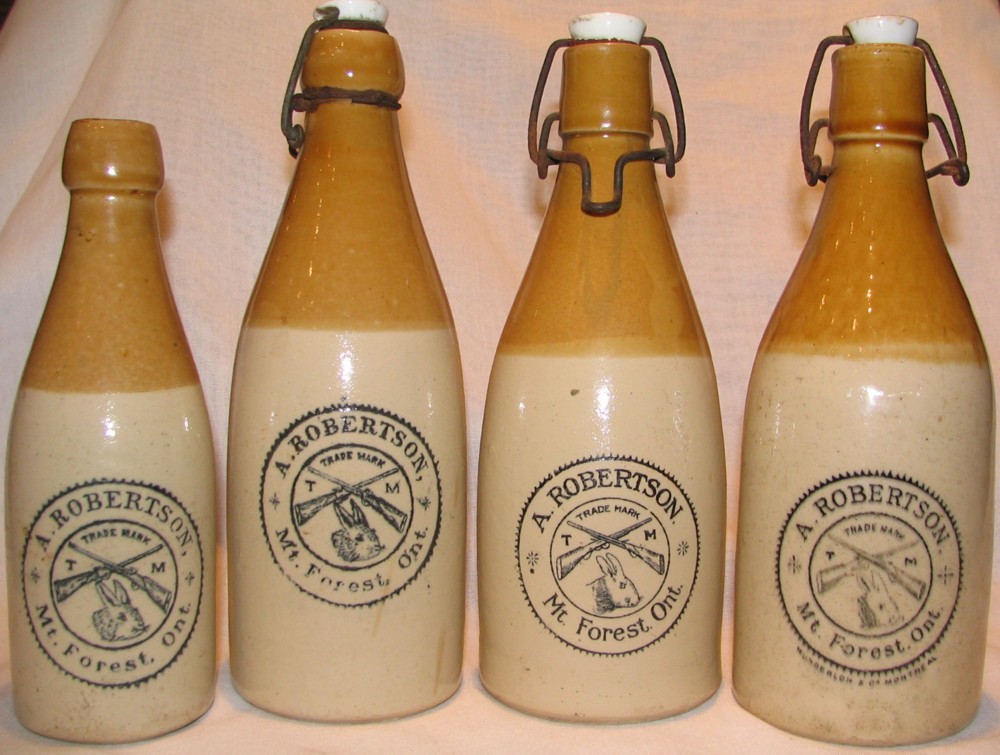
Timbits and I watched in envious amazement however as Jason successfully removed a medium sized, A. ROBERTSON / Mt. Forest Ontario gingerbeer bottle in good condition. For once, Tim was impressed. ‘That’s a pretty good piece’ he was heard to remark. It must have broke his heart to realize he had quit the hole too soon, and now had no claim what-so-ever to this discovery.
ALEX ROBERTSON & CO was a soda water manufacturer in the once booming and now ghostly Mount Forest, Ontario which can still be found at the major intersection of Hwy 6 and Hwy 89 (Queen Street) in nearby the township of Wellington north, in Wellington county.
 When pressed, Tim yielded more information on Alex Robertson – the company is listed in some early industry index he has as ALEX ROBERTSON - MANUFACTURER OF SODA WATER AERATED WATERS AND POP 1893-1919.
Tim sent me a photo of all four known Alex Robertson gingerbeers. Starting from left to right they are valued at approximately $900, $750, $500 and $150 respectively. Jason Hayder had found #3 in this series and his prize, slightly blemished, will probably fetch between three fifty to four hundred dollars on eBay.
‘Come on guys?’ Jason was giddy as he picked up his shovel and tried to rally us again for one last push into the breach… But Tim shook his head no and turned away. Then Jason stubbornly started shoveling again and refused to climb out of the hole; he urged us to stay and watch him complete one more cycle. But we were spent. Laughing at the cruelty of Meaford dump, and the insanity of Ace’s obsession, Tim and I walked away. My duffel bag tinkled with hackers as we tripped back to his truck.


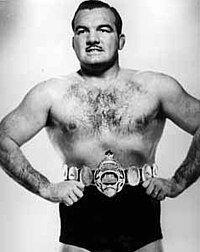

 Watson soon became a crowd favourite, one of Toronto's most popular citizens. Within a few years he was a
mainstream celebrity made famous by his repeated wrestling victories and their coverage on newsreels. Frank Tunney
a famous wrestling promoter in Toronto estimated that Whipper Watson drew more than five million people into
main events at Maple Leaf Gardens over the span of his long career. As one of the most popular wrestlers in
the city’s history, Watson spent 31 years entertaining fans. His debut
at Maple Leaf Gardens was on October 3, 1940, and his last match was held there on November 28, 1971.[1] when he teamed up with Bulldog Brower to beat Diego the Sundowner and Man Mountain Cannon in less than five minutes.
Watson soon became a crowd favourite, one of Toronto's most popular citizens. Within a few years he was a
mainstream celebrity made famous by his repeated wrestling victories and their coverage on newsreels. Frank Tunney
a famous wrestling promoter in Toronto estimated that Whipper Watson drew more than five million people into
main events at Maple Leaf Gardens over the span of his long career. As one of the most popular wrestlers in
the city’s history, Watson spent 31 years entertaining fans. His debut
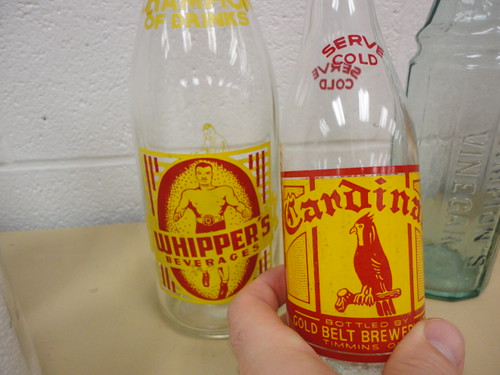
at Maple Leaf Gardens was on October 3, 1940, and his last match was held there on November 28, 1971.[1] when he teamed up with Bulldog Brower to beat Diego the Sundowner and Man Mountain Cannon in less than five minutes. The green glass varietals of this same bottle generally fetch more money at auction as they are rare and very pretty and definitely part of Toronto and Canada's history. Paul Huntley tells me that he has "... seen them go from $25.00 each to $250.00 each depending on who was there or not there (at the auction)." but he adds that "...not many of them out there as they are collectable in the soda world. You see about two a year come back out to auction."
 In wrestling, Whipper Billy Watson was known for executing two signature wrestling moves; the Canuck Commando Unconscious move which was essentially a sleeper hold, and what wrestling fans would call a finishing move, and the Irish Whip which was a another hold, and although it was a dramatic gesture, which was invoked with 'lots of velocity' from what the commentators say, I can't figure out exactly what it was ... Some more research is required, to learn exactly what the maneuver was, and how it was executed. Perhaps I should look on the backs of the soda pop bottles, for according to Jim Dixon there are as many as eight different wrestling moves illustrated on the backs of these rare pop bottles and that makes collecting these specimens even more challenging. Now that I think on it, I'm not really sure why Jim Dixon put his Whipper on the table as it doesn't really match the theme of 'Animal Night', unless he was suggesting that Whipper Billy Watson was an animal, in the ring.
 HUTCHINSON Colic & Kidney Cure from Brampton Ontario was priced at $1.50 per bottle.
 .JPG)