Saturday, August 23, 2008

Mother of all Antiques Shows in Chicago, Oct 3 - 6

Lauren Finch recently emailed Dumpdiggers some kind of praise to compliment the overall caliber of writing and high quality appearance of this blogspot. Turns out she's the Public Relations Manager of the Merchandise Mart Properties, Inc and she would like everyone in North America to know about the next Merchandise Mart International Antiques Fair™ which features more than a hundred antiques dealers in a wide range of categories, including: 20th Century Design, Americana, Architectural Design, Asian Art & Antiquities, Barometers, Books, Ceramics, Clocks, Decorative Arts, Folk Art, Furniture, Glass, Jewelry, Paintings, Posters, Prints, Maps, Sculpture, Silver, Textiles and Tribal Art.


California designer Kathryn Ireland will be the keynote speaker at this year's Merchandise Mart International Antiques Fair. This famous west coast interior decorator launched her design business in 1997, and has since worked with Hollywood A-listers David Mamet and Steve Martin (and many others). Kathryn Ireland’s keynote speech will be at 10 a.m. on October 3, the first day of the Antiques Fair.


From what I understand the Merchandise Mart is a huge historic building in downtown Chicago that's absolutely stuffed full of 'sets' that have been built by top designers to show antiques blending into everyday decor. This is meant to show sophisticated consumers how to best incorporate antiques & collectibles into their lives. The stuffy living room set pictured here looks like something from the Munster's... So this is an example of ornate furnishings blending into a genteel decor.


Personally I think the lamp with the white shade has to go. Who put that there? It ruins everything.


Friday, August 15, 2008

CORO 1960s Sapphire Flower Brooch - NO SALE

This beautiful piece of costume jewelry is a CORO vintage Sapphire Flower brooch with enameled leaves and petals. It was made by this jewelry company in the mid 1960s and features a blue crystal at the tip of the stamina inside the flower blossom. I liked the design a little too immediately, and I confess now to buying the piece on aesthetics (but for a very low price...). It does however bear the mark of CORO on the rear and is therefore a signed piece which was my only mandate.

However, it did not sell on eBay, where it was listed in a seven day auction with very reasonable shipping fees priced at $9.99 as minimum bid.

The back story here is that I paid that Russian lady, Stanya, only $8.00 for the piece at The Sunday Market four days before... I know her husband through a swimming pools installation company, long story, but yes I was hoping to 'flip this brooch' using the buy local / sell global principles, but it didn't work.

Social marketing? I was also hoping that through social marketing on the internet I could generate some interest in the artifact. I knew I was destined to write more on the subject - one more interesting blog post, or article about the experience of actually selling something for a profit on eBay... but it didn't happen this time.

AMOUNT INVESTED $8.00 + $2.00 eBay fees = $10
AMOUNT RECOVERED = $0


Dotty Stringfield gave me more insight on the subject of which costume jewelry designers are the most sought after on eBay. CORO is too common (and nobody wears brooches anymore) so my first attempt was literally doomed to failure before it began... why didn't anyone tell me what I already knew? I blame it all on Stanya.

Now this from Dotty Stringfield's costume jewelry research site:

Dumpdiggers,

Really good pieces from the following are always hot: Haskell (there is a lot of fake Haskell on ebay), Sherman, Har, Schiapparelli, Mazer, Trifari, Schreiner, Boucher, Pennino, Chanel, Eisenberg. Figural pieces are also popular -- people dancing, etc.

Most of the costume jewelry companies made a wide range of jewelry, from the ordinary and forgettable to exquisite, high end pieces. Others simply stuck with making lower end pieces by the thousands. Just because a name is on the piece of jewelry, that doesn't make it a desired item. Design, rarity, company name, etc., all play into whether or not a piece will bring a high price.

:)Dotty

Thanks Dotty. I guess its time to start reading books on the subject? Wait... Am I really that interested? After I buy my next set of earrings, ring, necklace or bracelet, I'll buzz you again Dotty, and maybe you can give me some idea of the proper keywords I need to plug the items into eBay most effectively? For example, I didn't think to mention the enameled leaves and petals of this brooch until you pointed it out.

Anybody want a CORO vintage 1960's Sapphire Flower brooch? I'll give it up to anyone who asks nicely in the comment box (and pays shipping?).

Wednesday, August 6, 2008

Fine Antiques at The Sunday Market in Toronto

August has five Sundays, and that's good news for Dumpdiggers addicted to shopping for high quality antiques & collectibles at The Sunday Market in downtown Toronto.

Every Sunday, St Lawrence Hall is stuffed full of opportunities for the wise old man that buys and sells history.

Dumpdiggers is absolutely obsessed with the idea of buying locally and selling globally on eBay. And now it occurs to me that costume jewelry could be my new specialty; beautiful pieces are more plentiful here in Toronto, and some items that are common here could be rare and valuable elsewhere in the world, esp if it's a good quality piece, and signed by a designer. I just need to know which ones to buy...

The Sunday Market in St Lawrence Hall (on the north side of Front St at Jarvis directly across from St Lawrence Market Bldg) is the best place in Toronto to play the Buy Local / Sell Global game with antiques.

Every Sunday morning all year long this venue is jammed with experts selling merchandise to the public on long tables. Every square inch is used.

I have my theories about these characters... Why are they all so rude here? Even the nice old ladies act badly toward me here? and why do they all shy away from my camera? If you take the time to learn their personal stories, you’ll find a lot of jaded shopkeepers in here. Many are ex-antiques dealers that have had to close their real stores after being squeezed out of expensive downtown property, and now they have houses full of merchandise which they must liquidate before they die.

THE VENDORS: A lot of senior citizens and people in their late fifties that are receiving disability cheques from Workman's Compensation will sell antiques to supplement their incomes. And they definitely don’t want their pictures taken!

As I walked around the building at 11:30 am Sunday Aug 3rd I counted several conflicted proprietors shying away from my invasive photography – and yet they remain in their booths as paranoid persons interacting with the public!

Here's old Herbie Bangle nervously watching me from behind an excellent collection of military medals and Canadian Armed Forces collectibles - there's over two hundred different silver tea spoons in that display case on the left and most are priced between ten and twenty dollars.

Yank Azman, an old friend of Dumpdiggers, hammed it up for me and tried to pretend he didn't want his picture taken... I know better. Yank is a professional TV actor and talk show guest – he’s an old friend of Dumpdiggers and was host of ill fated TV project called Flea Market Millionaires back in July 2001.

Yank closed his store (in the bottom south west corner of the Harbourfront Antiques Mall) three years later but is still selling his merchandise on Sundays at the St Lawrence Sunday Market – he was a legend at Harbourfront where his Antiques for Men and Fearless Women was the coolest and most original booth in the entire complex.

Right after catching up with Yank I encountered a marvelous Russian woman named Stanya who had a hundred or more pretty pieces of costume jewelry for sale on her table – but very few items were signed.

When I asked her to show me the signed pieces only, she obliged and displayed each example under a magnifying lens. I feel in love with #4.

But I didn't want to buy a brooch. They are not functional, and all but forgotten by modern fashion. They are not sought after by anyone anymore. Personally I don't think they're that relevant in today's fashion. But yet I couldn't help but like this strange little item. When Stanya showed me this marvelous sapphire glass green enameled flower that is at its most basic level, a clothing accessory, I forget all about my anti-brooch policy.

One look at the blue green enameled flower blossom and I was smitten!

So I bought it. And now...

This brooch is FOR SALE ON EBAY

I won't say how much I paid Stanya at The Sunday Market on Aug 3rd, but I will reveal everything in a new blog post on Aug 13th after my seven day eBay auction ends! Then I'll reveal if I made any money 'flipping' this item as per the terms of the Buy Local Sell Global game.

Eager to know more about the item, I researched CORO on Morning Glory Jewelry when I got home that afternoon.

Later in the week I found out from Dotty Stringfield that my brooch has a 'sapphire colored glass rhinestone, and enameled leaves and petals'.

Coro is the amalgamation of Cohen & Rosenberger and was began early in the 1900's in Providence, Rhode Island. As CORO they're familiar to all costume jewelry lovers.

CORO made jewelry from about 1920 until the 1970's and probably did it under more different names than any other maker. Vendome (1944-1979) , Corocraft (1935-1980), and Duette are just three examples. In general, the Coro mark was on the more modestly priced jewelry. Corocraft, Vendome and Francois were the higher priced lines. Adolph Katz was one of the best known of the designers, but there were many others responsible for the wonderful style of Coro jewelry.

Coro made soooo many pieces over the years that it is often hard to actually identify any one individual piece. Dotty Stringfield believes my brooch was made after 1960, as they started using 'textured backs' at that time. The 'smooth backs' used before that period were much more labor intensive, and therefore more expensive to make.

Here's another helpful website resource for researching costume jewelry: http://www.jewelrypatents.com/ is owned by Dotty's friend Jim Katz.

Dotty Stringfield's research site: http://www.illusionjewels.com/costumejewelrymarks.html

Tuesday, August 5, 2008

New Holes in east Toronto Lakeshore


new holes toronto2, originally uploaded by Scipio69.

Dumpdiggers is just amazed at how much digging is happening on the Lakeshore this summer. This hole evidences an active team tunneling about in the wastelands, or what I like to call the 'Golden Triangle' of old Toronto.

Here's the overgrown aftermath of a good hole and the pay dirt was easy to find after a little bit of grass cutting the bottles were just below the surface. Look at the hackers! There's an ACME brand dairy bottle, shoe polish, cosmetics, flasks and a blank umbrella ink, and a nice brown whiskey bottle standing tall among the bottles that were left behind....

The hole itself looks like it went deep, and I know from experience that you have to go way down through a lot of crap in this particular area if you hope to find anything good. Did they find anything good? I wonder who dug this hole?

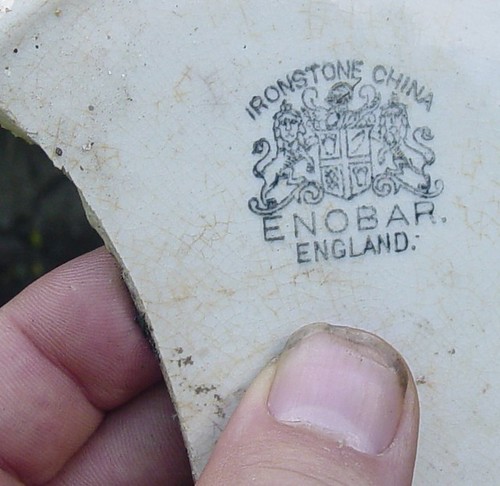
Among the shards I found this pottery stamp - I like the lions. Here's an excerpt from lean manufacturing
In 1813, Charles James Mason, of Lane Delph in Staffordshire, introduced "Patent Ironstone China." Mason used a mixture of Cornwall clay, ironstone slag, flint and blue oxide of cobalt to produce a hard, opaque, bluish white pottery that had a smooth, glossy finish after glazing and firing.

Does anyone know anything about ENOBAR? Other than the obvious fact they made Ironstone China in England?

Sunday, August 3, 2008

Cleaning Up after Toronto's Caribana Parade

Scavengers spend Sunday morning sorting through the remains of Toronto’s Caribana parade.

On Sunday Aug 3rd at 9:30 am the entire west Toronto lake shore (a green space bisected by a bike path between Exhibition Stadium and Sunnyside Pavilion) was strewn with ALL MANNER of garbage! It was like the park had a 'hang over'; the desultory scene evidenced a wild party. Toronto’s Caribana revelers must have stayed late into the evening. And then in the morning an army of garbage pickers created a real mess as they overturned trash cans and combed through heaps of rubbish on a quest for recyclable beer and wine bottles.

Although the Caribana parade has struggled with its finances in the past, organizers believed this year's event would turn a profit – it must have. I know the island flavoured festival received increased funding this year because there were more sponsors – gun violence, and severe traffic jams due to critical lack of planning blemished the corporate politics of the previous Caribana parades.

Official reports are that tourists who come to Toronto for the gigantic celebration pump almost $300 million into the local economy. There sure do make a lot of unusual garbage.

Among the white shopping bags and Styrofoam containers, there were lots of crazy costume remnants and cool signage, unusual colored fabrics and sticks and broken lawn chairs. I saw an inflatable pool, a bent unicycle, and lots of single shoes and sandals - it must have been quite a party. You couldn't rent this stuff at a Toronto party rentals store... it had to come from home.

Black garbage bags filled with fried rice were split open and some of these bags looked like they’d been stepped on a thousand times – I'm sure a food tent had been erected in the vicinity.

Hundreds of green coconuts were lying open twenty feet away – this was no doubt the remains of an all natural fruit drink stand.

Farther up the path the lawn was absolutely overflowing with debris and the wind was pushing it everywhere – the nearby garbage cans had been turned on their sides. It’s quite obvious that scavengers picked through every single garbage can in their unquenchable thirst for recyclable beer and wine bottles. And I spotted a few stubbies and some questionable foreign beers that had been left behind by the experts.

Dumpdiggers would like you to imagine the Brock St. beer store, at 10:55 am on Sunday morning. That place must have been jammed with people returning thousands of beer and wine bottles.

This Toronto City Worker wouldn't stop to pose for photos. Apparently the Mayor of Toronto, David Miller specifically asked today’s clean-up crew not to allow themselves to be captured in photos or to make any comments to the media. I merely asked her about the different types of scavengers about, and I could see that see wanted to tell me something… I asked some more questions and came to learn there were indeed whole families here picking bottles a few hours earlier, and these were followed by a more degenerate sort who harvested food and other amenities.

Which brings us to Mr X.

At 9:45 am I ran into this hero – a wise old man with the metal detector.

Dumpdiggers hoped to celebrate the presence of this high tech smart guy and write about his wisdom in every detail, but that wasn’t going to happen – when he heard the words ‘Dumpdiggers’ and ‘blog’ he practically ran to his bicycle.

Here is the absolute smartest scavenger of the day, but he definitely didn’t want his picture taken or his story shared. He refused any insight into his genius.

So I can only imagine his routine. He carries a screwdriver as a simple probe and swings his coil over the chlorophyll, listening for the tell tale signs of a lost diamond earring or a gold ring. And coins; I’ll bet he finds lots of fresh nickels, dimes and quarters.

Here’s a question; would the device he’s carrying pick up the signal of a Canadian loonie? I don’t know. What are loonies made of again? I bet it would detect a toonie though as I'm sure that has nickel in it...? right? What are the exact metallurgical compositions of Canadian One and Two Dollar coins? Anybody - reply in the comment box. I wonder how much money he would make in pocket change alone? Dumpdiggers hopes this shy metal detectorist makes more money than the bottle pickers.

Saturday, July 26, 2008

Paul R. Johnston, A Forgotten Canadian Painter?

Harold Barrett, the proprietor of Pickwick’s Choice Antiques at 1698 Queen St West spared some time to chat with me and pose for some photos today. This man is a treasure. My Saturday afternoon visits with this colorful character are the high point of my week. Every encounter is different as Pickwick discusses the fascinating trends in his life – I could start an entire new domain on The Life of a Queen St Antiques Dealer. It actually bothers me that his knowledge is wasted in this dusty shop in the antiques ghetto of Toronto. Phone him at 416 538 4419 and ask him anything!


Harold Barrett advises collectors to ‘buy Canadian art right now!’

But some conditions apply. Namely the modern Canadian artists must have some credentials and some record of their achievements and gallery shows. Where did they go to school? Who taught them? What did the critics think of their work? Did they join a movement?

Pickwick didn’t need any persuading to show me one of his best pieces. It’s hanging on the wall right behind the counter, for sale, a bargain at $695. This piece is something of a scarcity in the Canadian art world because it’s from the son of famous painter…

There's no Wikipedia file for Paul Roderick Johnston - the son of Franz Johnston? I can't find any hard data on this man. Even in Frank Johnston's wiki page there's no mention of any children?

Paul R Johnston is how he signed his name to this oil on canvas, entitled Winter Landscape near Wyebridge. It's 20x16 oil on canvas that was priced at $100 in 1945 - the artist dated his work here by writing the numbers 44 behind his signature. Pickwick believes this was sold at a gallery in downtown Toronto in 1945. 'Do you know how much you could buy with $100 in 1945? he asked me and then replied 'It was three months wages for most people.'

According to Pickwick, Paul Roderick Johnston was the son of Mr. Franz Johnston who lived from 1888-1949. Francis or Franz was an original member of the Group of Seven, but only showed in the Group's first exhibit where he displayed over sixty paintings - more than all the other members.

Franz painted differently than the other Group of Seven members. He liked close-ups that often seemed crowded, and demonstrated incredible prowess in simple landscapes with subtleties like clouds reflecting on water.

Here is Franz Johnston's classic LANDSCAPE AND SKY STUDY signed; inscribed "The Weather Breeder" on the reverse, inscribed title – it was sold in November 2006 at Ritchies, and the estimate reads between $7000 and $10,000, but I don’t know how much was actually paid or if the artwork was even sold. This painting is exceptionally beautiful, in this author's opinion. Dumpdiggers proclaims this to be a terrific investment at $10K and a steal at $7K.

According to Harold Barrett of Pickwick’s Choice the artist known as Paul R. Johnson was the son of this famous Franz Johnson. I have to believe him. The back of the painting proudly declares the artist’s pedigree. *Although if you read the comments below, some say Paul was eager to find success without using his father's name. REMARKS - Bright landscape by son of Famous Franz Johnston – ARCA

What does A.R.C.A. mean? Academie de Royal Canadian Artiste hmmm… no?

According to Charles Moffit of Lilith Galleries.

ARCA stands for Association for Research into Crimes against Art.

In Winter Landscape near Wyebridge, Paul paints like his father - Franz Johnston's style became increasingly more realistic throughout his life, evincing a particular fascination for the qualities of light reflected from snow. Like his father, Paul explored river valleys and detailed the bright blue water bending between snow-laden banks. Like his father, Paul also painted the pastoral countryside around Wyebridge, Ontario.

A reader named Jane Christmas emailed me these images of artwork hanging in her home - see below in the comments, the pedegree. She writes, Hi Rob: I've attached some photos of Paul Rodrik's paintings, and one by his daughter Zo Alexis. Thanks in advance for posting them. Jane

Saturday, July 19, 2008

Hunting Bottles in an Old Barn

On Thursday July 17th The Glove mustered skilled workers to help him repair a weather beaten structure that stands alone on some property he recently purchased, just west of Warkworth Ontario. Dumpdiggers answered the call - but only so we could rummage about in the forgotten history of the old barn.

This old barn sits alone on the south side of Hwy 29 which bisects a historic local region known as Oak Heights. This structure has survived the farm house and all other buildings on the property and now towers over their cement foundations – it has even outlived the United Church which was the focus a tiny farm community, one century earlier.


The barn was built almost 100 years ago, and was probably erected right on top of a smaller, earlier structure on the same spot. For the last forty years, this farm was owned by Eddie Dudeck who died just a few years ago. He was an eastern European immigrant (Polish?) , a tobacco farmer, and something of a land baron. Many of the local residents worked for him at one time or another, including my own father.


This barn did not exist in the 1870s, when the settlement was first surveyed for the Northumberland Co. 1878 map available in McGill University's Blackadder Digital Collections. Here's a cut away that I fashioned which shows the property belonged to Johnson Brewster. His 200 acre lot also supported the church. On a side note, my own ancestor's original plots are also recorded here. My great, great, great grandfather George Campbell died when a rock he was burying on his land tumbled in on top of him. The family legend is that he's still there somewhere on that farm, underneath that rock.

All around the stone walls outside the building is the best place to find coins, old pocket watches and spent ammunition. The first thing I noticed when I approached the site was how much debris and loose material had collected over time against the stone foundation. It was easy to shovel through this fluffy matter - yes thats cow dung in the right hand side of the picture. Littered with crumbling barn boards, buckets, and straw bales, the surface debris rests on top of some harder sub soil that conceals older relics. I have no doubt that some concentrated digging and sifting on this site would yield all manner of old coins and broken tools.

In some situations Dumpdiggers employ passionate enthusiasts to retrieve surface objects. These people are specially trained professional who don't mind doing a little dirty work when it comes to recovering our valuable heritage. Here's young Alec with a quart of port. When we opened the bottle it still looked remarkably palatable - it smelled pungently like overripe wine vinegar. A distiller could no doubt refine this fluid into the finest moonshine.

The wooden floor boards above the drive shed are carpeted in rotting tobacco, which I tried to photograph, without success. The decomposing plant matter now perfumes the air in a musty fragrance. Underneath the ancient straw in an adjoining hay mow I found fertilizer bags and newspapers, one of which was dated September 1976 - Dumpdiggers believes this pinpoints the last summer the barn was used in any serious agricultural enterprise.

The dividing wall between the hay mows. If I had more time on site I would dig away the straw and loose leaf tobacco from around the short wall that bisects the interior of the barn. This is where Dumpdiggers would have the best chance of finding lost coins, jewelery and spent beverage bottles.


Here are some old beer bottles that have already been recovered on this site. The labels on the bottles read, O'Keefe's Extra Old Stock Ale, Molson's Stock Ale from Montreal, Bradings Old Stock Ale, and IPA. The Glove believes this wide selection of 1970's era paper label beer bottles evidences teenagers dipping into their father's coolers and meeting here in ritual drinking. But I don't agree. I suspect these old bottles are the scattered remains of a late 70's era tobacco season harvest party wherein it was customary to provide young workers with a massive selection of commercial brew craft upon which they might deliberate their first taste of alcohol.


Buying and selling historic lumber sounds like a good business. Here's a Canadian website that buys old barn boards. Pine was the building material of choice for old barns in the 1800's. This abundant local wood survives the elements untreated – pine doesn’t shrink when it dries. All this is because pine has a natural resin (which is distilled to make turpentine?) that coats and protects its fibrous cells. Cedar also has a natural oil, but this wood doesn’t last as long outside and doesn’t grow to the size of pine logs.

The north wall of the stable bears the marks of an unsympathetic addition; the window boxes on the east side are an entirely different shape. This means the barn was expanded at some point and the oldest diggings would be found around the north wall.

Explore the tops of all stone walls. When I ran my hand above the window boxes I encountered all manner of rusted objects – old door knobs and electrical boxes and even a spring loaded wooden mouse trap that fortunately wasn’t cocked. There were spent shotgun shells and a few small tins, oxidized beyond all recognition. Dumpdiggers also found lots of square nails and a broken lock.

This is just one historic property in transition - the rolling hills of Northumberland County seen here in the distance will soon be enhanced by gardens, fruit trees and a cute little animal pasture in the foreground. That's probably how it looked on July 17th 1908 when this barn was the center of activity on the Brewster farm.