 Five things to collect for cash on eBay the next time you walk along the beach.
Beachcombing is becoming popular again – a morning stroll along the beach with your lover is even more enjoyable after a storm when the sand is strewn with eBay items.
 2. Fossils
Dinosaur fossils have been found on every continent of the globe, from Africa to the Arctic. When someone finds a fossil, they grow curious and tend to keep their eyes open for more specimens - before they know it, they have become fossil hunters! Fossil hunting is a very infectious obsession, and today more people than ever are collecting dinosaur bones, and eBay prices have risen accordingly.
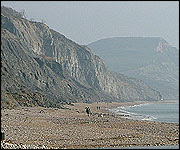
 Generally speaking, one of the best places on the planet to find dinosaur bones is on the beach. That’s because the waves from the lake or ocean have already done all the hard work and broken apart coastal rocks and washed away surface mud to leave well preserved fossils in the sand. All you have to do is pick them up.
Limestone beaches and cliffs are often especially rich in dinosaur fossils as they evidence a prehistoric environment that favored fossilization - one in which sediment buried the animal during, or shortly after their death.

You can expect to find some fossils loose in the limestone shingle (gravel), for example small ammonites, belemnite ‘guards’ (small bullet shaped objects), and even perhaps an ichthyosaur vertebra. If you persist, and as you gain experience, and with a bit of luck, you'll soon make more exciting finds, such as even a complete ichthyosaur.The business of selling fossils online is growing larger every year - last summer (July 2007) The BBC reported that
Fossil Guards have been hired by local government to protect the Dorset and east Devon coast amid increasing concern about safety and damage to the limestone cliffs.
The area is
known as the
Jurassic Coast as so many fossils have been discovered here (over hundreds of years), the coastline has earned its own World Heritage Site status.
 Believe it or not there are only about a dozen full-time dinosaur paleontologists in Canada, and they mostly concern themselves with excavations in the badlands at Drumheller, Alberta - this section of Canada is rich in dinosaur bones that are a distinct orange color.
But fossils come in many different colours. The ground minerals that replaced the organic material in the prehistoric animal’s bones determine the color of the fossil. Perfectly preserved, the plant and animal remains of the Paleocene Epoch could be black, brown, pink, yellow or green depending on the mineral composition of the beach.

Fossils range in size from microscopic plant pollens to complete dinosaur skeletons. When poking around in the shoreline – be sure to remember where you find each fragment; bones visible in one stone can often lead to a larger fossil in another rock. The most well preserved discoveries are always those in which no part of the skeleton is initially exposed, but it takes skill to find these items.
A paleontologist’s trained eye can often spot the small exposed portion of a specimen and reason the direction and approx length of the body inside the rock. ‘Uncut fossils’ can be sold on eBay to other specialists who use advanced cutting equipment to remove the rock and showcase the fossil inside.
When combing beaches for the fossils, you should also be on the lookout for petrified wood, clams, snails and shells plus fossilized whale and dolphin bones. If however these are found embedded in the face of nearby cliffs, do not attempt to remove them, as your actions will have a deleterious effect on the surrounding landscape.
Dinosaur fossils are increasing in value on eBay as more and more collectors attend shows, download e-books and join online fossil photography groups. Poorly photographed pieces are sometimes bought, rephotographed properly, and then re-sold for more money.
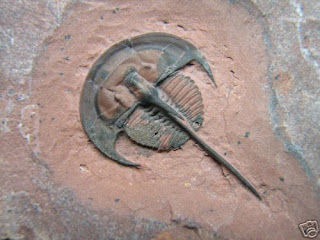 Here’s a Norwoodia bellaspina on eBay. For six hundred US dollars you could own this Trilobita class fossil. Its 18,5 mm long x 11,5 mm across; although not rare, this specimen is complete and shows beautiful details.
Another popular item on eBay is extinct Sharks teeth – the teeth of the Carcharocles megalodon , which most experts believe to be the largest predator (land or sea) to have ever lived. The maximum length this shark is hotly debated today, ever since paleontologists learned that they could get more accomplished by disagreeing with one another. The most widely accepted maximum size for the megalodon is approximately 55-65 feet; at minimum, the megalodon was at least two or three times larger than the Great White.
 The megalodon teeth found on the east coast of North America sell well on Fossil Beach. Those teeth are 75-85% complete and most have minor blemishes or cracks. This lot is being sold for $215.00 a pound and will probably end up in a children's day camp, or schoolroom science display.
Fossils are by far the oldest category of collectible antiquities - most animals lived between 235 million to 65 million years ago. Also please note that term 'dinosaur' refers only to the land based life forms, which are distinctly different from the flying creatures (pterosaurs), and the swimming reptiles (mosasaurs) of the same period.
 Finally, Dumpdiggers has its eye on an excellent 'deposit' of Coprolite from Southern Utah. Coprolite is fossilized Dinosaur poop and this offering is around 148 million years old, from the Jurassic Era. This eBay item has an outstanding dung pattern and a very cool shape - the Seller has advertised this as 'an excellent one of a kind display specimen'.
Perhaps this should be a separate post - ‘Dinosaur Dung sold on eBay!’

 Five things to collect for cash on eBay the next time you walk along the beach.
 2. Fossils
 Generally speaking, one of the best places on the planet to find dinosaur bones is on the beach. That’s because the waves from the lake or ocean have already done all the hard work and broken apart coastal rocks and washed away surface mud to leave well preserved fossils in the sand. All you have to do is pick them up.
 You can expect to find some fossils loose in the limestone shingle (gravel), for example small ammonites, belemnite ‘guards’ (small bullet shaped objects), and even perhaps an ichthyosaur vertebra. If you persist, and as you gain experience, and with a bit of luck, you'll soon make more exciting finds, such as even a complete ichthyosaur.The business of selling fossils online is growing larger every year - last summer (July 2007) The BBC reported that Fossil Guards have been hired by local government to protect the
  Believe it or not there are only about a dozen full-time dinosaur paleontologists in
  Fossils range in size from microscopic plant pollens to complete dinosaur skeletons. When poking around in the shoreline – be sure to remember where you find each fragment; bones visible in one stone can often lead to a larger fossil in another rock. The most well preserved discoveries are always those in which no part of the skeleton is initially exposed, but it takes skill to find these items.
 Here’s a Norwoodia bellaspina on eBay. For six hundred US dollars you could own this Trilobita class fossil. Its 18,5 mm long x 11,5 mm across; although not rare, this specimen is complete and shows beautiful details.
 The megalodon teeth found on the east coast of North America sell well on
  Finally, Dumpdiggers has its eye on an excellent 'deposit' of Coprolite from


.jpg)

