Wednesday, January 25, 2017

Two More Deep Holes 'Back in Time' Scheduled for Front Street E in Toronto

The St Lawrence neighbourhood is getting a 'Residential Rebirth' as per Toronto Waterfront Magazine, and that means excavators will soon be cracking through the asphalt and digging deep holes down through the history of the city to make the necessary underground parking garages. And that gets Dumpdiggers excited.

When historic property changes hands, City administrators often hire professional archeologists to poke about and recover artifacts in the hopes of making a 'Toronto Museum' someday. Below is a picture I snapped on 16 Jan 2017 of the archeological dig happening on the site of the St Lawrence Market's north building. For years this was the site of a vegetable produce market on Saturdays, and I believe there was an antiques market on Sundays. Or was it the other way around? I forget exactly, but I do know that I shopped for antique bottles in this building, and there's a blog post about visiting the spot with Abel DaSilva somewhere in the archives here on Dumpdiggers. 
 
You can see in the photo above I've deliberately shown the portable toilet solution on site today as I enjoy the juxtaposition of seeing space age privies on a property which more than likely once boasted the crudest of latrines. That's where the best stuff is buried... but the book schooled archeologists are instead combing the foundations for clues to culturally relevant stories, and various historical mysteries and they're not 'relic hunting' for collectibles as we would do, although they have found some bottles and coins as per a January 7th 2017 Toronto Star article about the archeological dig at St Lawrence Market by John Lorinc

This dig is happening before construction starts on a mega mall vendor complex which some experts, John Lorinc included, have pegged at costing just over ninety million dollars. That seems cheap - look at this thing!

This complex, plus construction on the north side of the Distillery District plus the new condo towers at Esplanade and Yonge are pushing developer interest in the St Lawrence neighborhood. Properties in the downtown core preferred bits in a premier matrix of pre construction condominium investments in the city.

Extreme property development in Toronto is commonplace as dozens of skyscrapers are erected all across the GTA every year. But the two futuristic-looking monoliths described next are special. These giant concrete condo towers, both scheduled to begin construction on Front St E this summer, are situated on two of the oldest lots in town, and even appear on the very first maps. Click the pictures - they expand.

The picture to the right shows John Graves Simcoe's famous 1797 sketch of the Settlement of York with the present location of Time and Space condos clearly marked. You can see it's located right on the shoreline of the original grid. This graphic is borrowed courtesy of the Time and Space condos website's Time Traveler story from which I've re-purposed some other images and observations for this blog. I'm writing this post on Dumpdiggers as a community alert for shovel ready relic hunters and more refined collectors who prefer to deal directly with backhoe operators and excavation company owners (to buy dug bottles and bits at best prices). Lastly this is a story about the evolution of Front St E and what amazing things might be lurking under ten feet of top soil, buried a few  hundred years under the rest of Toronto's history.

Anyone comparing the two map excerpts will notice that Front St E was originally called 'Palace St' and was a waterfront expressway toward the site of the first Upper Canada Parliament Buildings. It was called 'Palace St' because it was the way toward the 'Palace of Government'.

In a recent article about the past, present and future of Front and Sherboune appears in Toronto Guardian 21 Jan 2017 and the author states that anyone walking south down Jarvis, George, Frederick, Sherbourne and even Princess will notice a pronounced dip down right after Front St. 
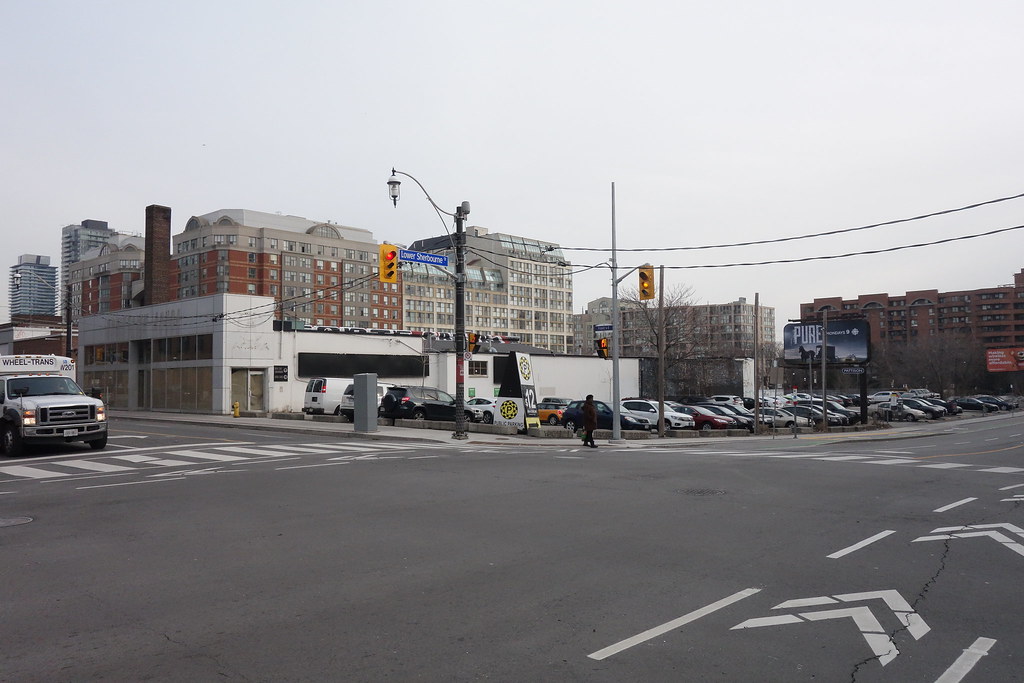
s.e. corner of front and sherbourne in Toronto

You can see the sudden 'dip' downwards in this image below that I snapped on 16 Jan 2017 of the south west corner of Front and Sherbourne as it appears today. There was an Acura car dealership and Sobey's grocer store here not too long ago. See that smoke stack? Keep an eye on it.

Go back forty years...  Newsome and Gilbert Ltd. printing plant was located at 177 Front St E in 1972. The old smoke stack is visible back then, but does not appear to be connected to the building. Newsome and Gilbert made high quality legal stationary for law firms across Canada and this facility probably employed a hundred people in the area. It was a modern printing plant and didn't use steam power but rather it required hydro electric power as evidenced by the many spars on the pole outside the building and only three spars on the pole at the corner in the foreground.
Go back farther - here is a sketch from 1893.
Now on the 1880 Goad Fire Insurance Map, you can see the center of the complex is being used by Lyman Bros Chemical Works.

Lyman was listed in the 1851 Canada Business Directory - LYMAN, BROTHERS & Co., wholesale druggists, manufacturers and dealers in dye stuffs and clothiers’ materials-also in paints, colours, linseed oil, putty, &c., and importers of perfumery and chemicals, St. Lawrence buildings, King st., east.    (the location of the retail store).


An environmental study for 177 Front St E Toronto dated November 20th 1989 by Trow,  Dames  &  Moore  For  Arnon  Development  Corporation reports the findings of a soil quality assessment study in which seven  (7)  boreholes  were  advanced  to  various  depths  across  the  site.  They found "..an  upper  fill  layer approximately 4 m thick on the west portion of the site and 3 m thick fill layer was identified on the eastern portion of the property.  The fill generally consisted of sand and silty sand with brick fragments, cinders  and  wood  fragments.  At  some  locations  the  fill was  observed  to  have  a  black  colour  and hydrocarbon odours. Shale bedrock was encountered approximately 7 m - 7.5 m below ground surface.  "

Given the industry on the property to date, its not surprising the soil quality assessment report revealed evidence of potential environmental contamination. They referenced the printing operation where chemicals were present in the buildings on site between 1950 to 1980.  The report mentions the former oil storage and chemical supply company (Lyman Bros) that was located within the central portion of the property from 1880 to 1940. The document pinpoints the positions of four different USTs (Underground Storage Tanks) located on and near the site from approximately 1960 to 1990. Most of the soil will have to be removed to make way for what's coming... 

Here's what's coming to the site in 2017. Time and Space Condos at 177 Front St E.

The other property that Dumpdiggers should be aware of is directly across the street, on opposite corner at 158 Front St E., the development is called St Lawrence Condos.
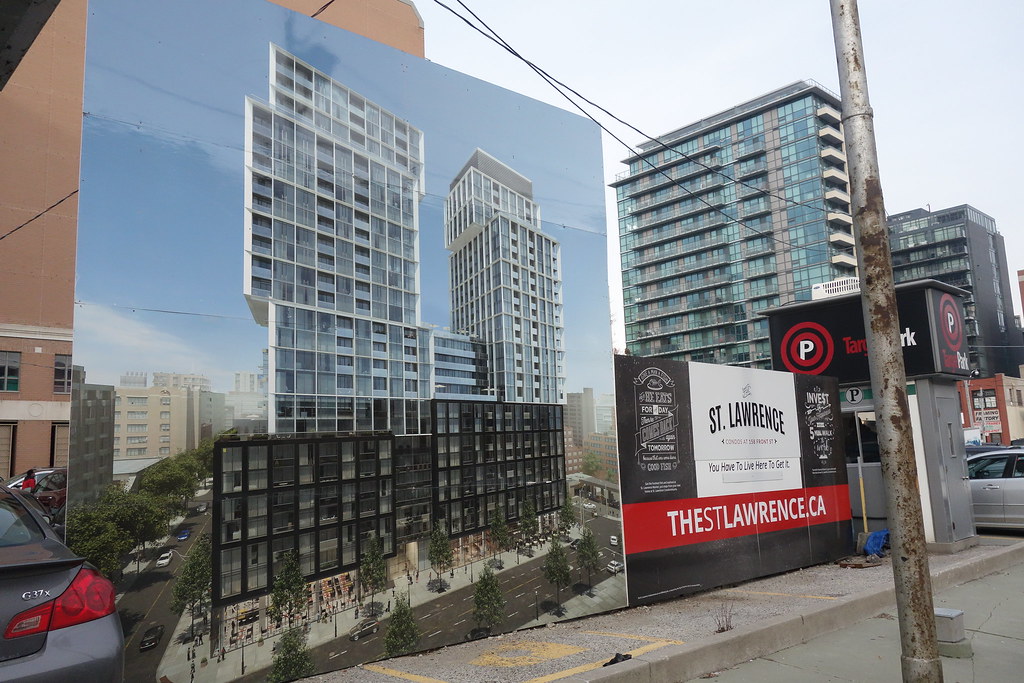
154 Front St E in Toronto - St Lawrence Condos , 16 Jan 2017
The St Lawrence Condos at 158 Front St E has an advanced design with a  ‘staggered blocks’ style appearance that's certain to turn heads. This is what the future looks like today.

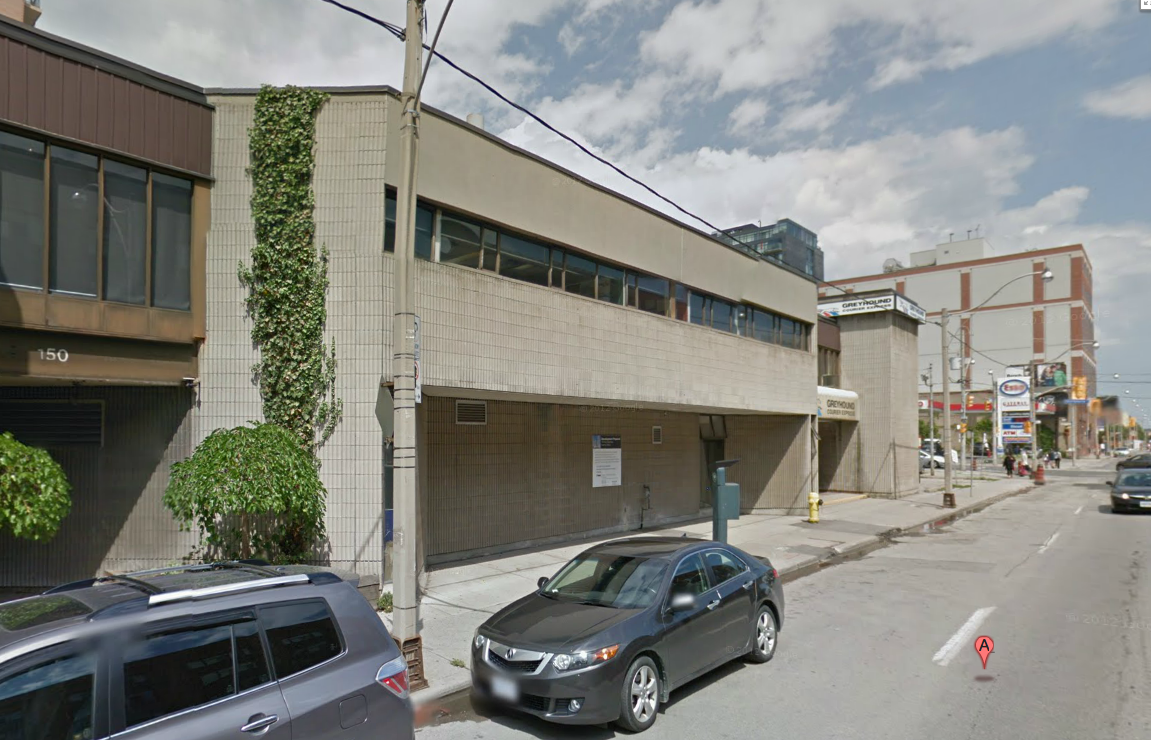
A photographer standing in this spot five years ago would have seen the Greyhound Bus Station that was just here. Demolished in 2011, that structure was built in the mid 1960s and for fifty years it was a prime conduit through which many people arrived in the city for the first time.
Close to the same spot, facing the same direction seventy years ago, an unknown photographer captured this street scene below.

Roy F. Day was a locksmith - The B/A sign is the mark of the British American Petroleum company.
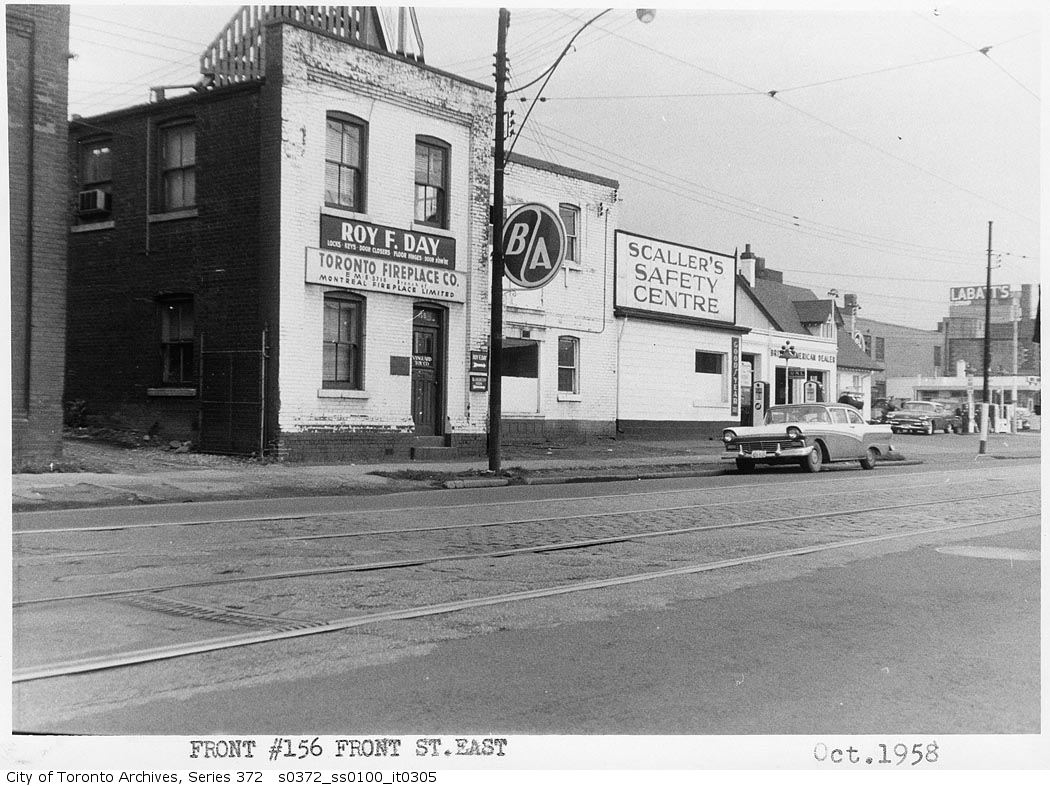
154 Front and Sherbourne, Toronto - 1950
Behold there was a gas station / automotive service station on both the northeast and northwest corners of Front and Sherbourne back in 1958. (there is still an Esso on the NE.E. corner today) Scaller's Service Station started in the 1930s with some connection to the nearby British American oil company. The business would have removed or greatly disturbed the archeological record of the site when they dug their fuel tanks.  I can only imagine what they unearthed.

Let's remember this old section of Toronto is where dozens of good bottles (highly collectible) are being filled with original contents in the 1880s. King St E is thick with druggist and apothecaries including Dr. Chase and Lyman Bros etc. Do you collect soda or mineral water bottles? The original bottlers are all around this property in the 1890 Industries of Canada book.
If the diggers find a privy pit it would be fascinating to do an archeological investigation of that and count the soda bottles and see which brand of local soda pop was the most popular (or least recycled) at the time in Toronto as dated by other relics found in the privy.

the property was surrounded by retail chemists, druggists, perfumers, soda pop manufacturers, breweries and distilleries back then and for a hudred years prior.  

PDF - There's a report done by Archeological Services Inc on behalf of the city of Toronto for 154 Front St. E and the information inside is solid gold. The document recalls the original Toronto Purchase and lists the payment terms and treaty irregularities. It lists the population of the city at various ties throughout the 1800s and also there's a complete list of owners for 154 Front St E from 1833 - present day.

1833   Back when the road was still called Palace Street, a famous gentleman named Thomas Mercer Jones Esq., who was one of the Commissioners of the Canada Company lived at a house on the lot.

Ten years later, in 1846 a man named Lawrence Coffee, who was a flour dealer, and Abraham Koplik, jeweler were on the site.

Ten years later, in the middle 1850s, Boyd and Armstrong started a hotel at what is now 154 Front St E and called it the Grand Trunk Hotel which I suspect rented rooms on long term basis as the census records are thick with occupants' names from this point forward. The residents are middle aged blacksmiths, flour dealers, and pork packers who probably worked across the street at Wlliam Davies pork packing plant on Frederick St - that building still stands today too.   

The Grand Trunk Hotel is called Ontario House in early 1870s and then becomes William Lennox's Hotel in 1875. Where there was a lodging house there usually a deep privy and so I've no doubt the property is loaded with little pockets of antique glass bottles today.

In 1895 we see the first mention of  William S. Mahaffy as a blacksmith. A few years later he's listed as 'carriage manufacturer'.
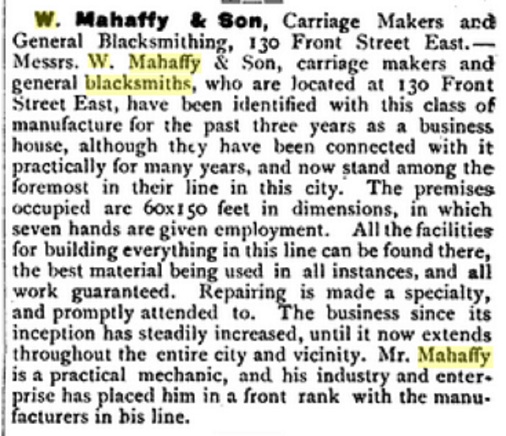
Same as H.A. Wickett Co. Ltd., general contractors in 1930. Wicket specialized in demolition afterwards - the Wicket Demotion company appears after 1940, along with Roy F. Day, locksmith.

In 1957 The Dominion Linseed Oil Co. Ltd. had some facet of their operations here at 154 Front St. You can read all about their historic buildings on the other side of town. The Dominion Linseed Oil Co. Ltd on Wabash (at Sorauren).

In 1965 the Hart Battery Co. Ltd. was here along with Precision Air Conditioning Ltd., sheet metal contractors and the Scaller Service Station which was part of the British American Oil distribution network.

In 1975 the Greyhound bus building was here (Gray Coach Lines)

And we all know what's coming. In the summer of 2017 I will be there interviewing excavators, taking pictures, and maybe even buying bottles and relics from the excavators at the gate.

Friday, December 2, 2016

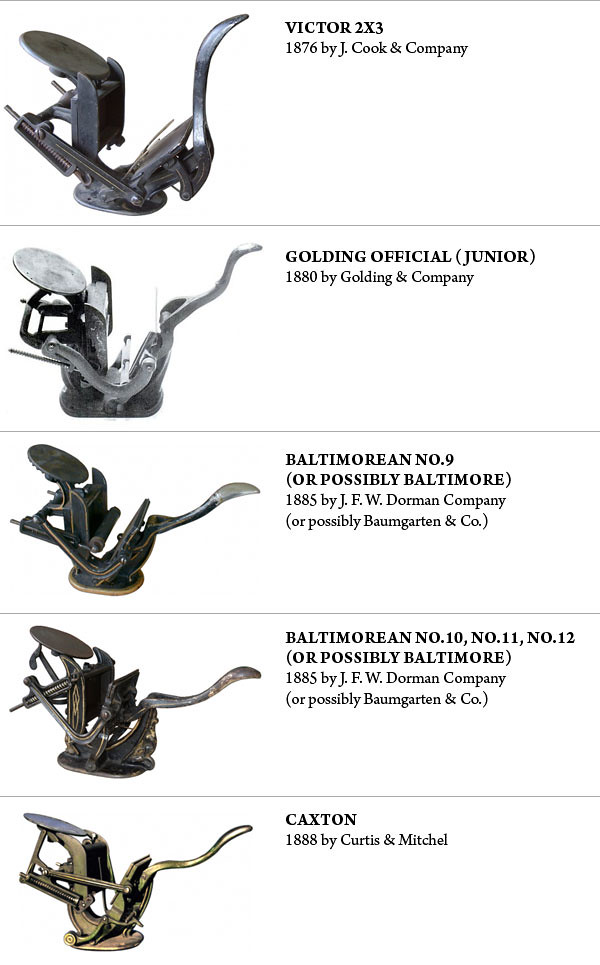
Baltimore #9 Printer, Custom Printing Solution for Business People in the 1880s

Let's marvel at the new trend toward making and maintaining office lobby museums.     When culturally clever merchants keep curious collectibles in their office lobbies and meeting rooms, the relics help convince visitors that the host business is historically important to all humanity.
Baltimore #9 Printer, for custom printing cards and stock labels
Storied items are key to corporate myth making; venerated implements can spark conversations that cause executives to be reflective and have more pride in the employer and more passion for their work.
Lorpon Labels is custom label printing shop in Toronto, Canada Having obsolete industrial machinery on display, or primitive scientific apparatus preserved under glass commemorates decades of experience and symbolizes expertise wrought from empiric success. Such is the case at Lorpon Labels custom label printing in Toronto, Ontario where I found a Baltimore #9 Printer on display in their front office. This is a relic from the 1880s and its still hard at work today, but not as a printing press.

Lorpon Labels Displays a Museum Quality Printing Press that was a Custom Printing Solution in the Late 1800s 

antique lever press at custom printing company in Toronto Canada
The Baltimore Printer #9 was a 'rail press', which is a modern term used to denote this type of printer where the action centers on a hand lever used to work the press. In their time these were called 'lever presses' and were the simplest printing machines available for purchase. They were deliberately small, cast-iron convenience presses capable of printing no more than a few short lines on a paper card.

At the tail end of the American Industrial Revolution these items were being sold new for one or two dollars each. The printer was always sold as part of a home printers' package that consisted of the press, an ink roller and a couple cans of ink. There was also a pair of tweezers and at least two boxes of type—all in miniature. Blank cards were available everywhere stationary was sold.
close up of Dorman Baltimorean printer type in chase on lever press
Rail presses were produced until early in the twentieth century when they were succeeded by even lighter presses made of tin-plated steel and often quite gaudily decorated.
view of ink platen in Baltimore 9 printer at lorpon labels
The new tin presses came complete with lightweight rubber type included in the package - these flimsy rigs were not strong enough to accommodate printers’ lead or steel type. The #9 Printer is an early version of more successful rail press designs that came later - this machine was made of cast iron and came with good solid steel type.
reemovable steel type in chase on wood in Baltimore 9 printer at Lorpon Labels
Spawned by America's rising demand for personal calling cards, the rail press was conceived as an alternative to professional printing. The marketing for other rail presses of the age appeals directly to businessmen for printing and numbering tickets, dating documents, and marking crates. By the 1870s these small card presses were made not only for shopkeepers, but for amateur printers and eventually even for children. The tin and rubber stamp models on the market at the beginning of the 20th century probably cost about fifty cents each and did a horrible job printing anything.

CEO Bob at Lorpon Labels plays with Baltimore 9 Printing Press
J. F. W. Dorman did NOT make Lorpon's antique; Dorman's firm produced a very popular range of hand lever presses that were closely copied by later manufacturers, notably Baumgarten & Co who also resided in Baltimore and also a man named Sigwalt who lived in Chicago. Dorman's Baltimoreans came first and were followed (copied) by Baumgarten's Baltimore No.9 and No.10 presses which are very similar with only minor differences in the casting and paint.

The Baltimore #9 Printer on display at Lorpon Labels was made by Baumgarten & Co who copied the design by J. F. W. Dorman, as per Briar Press Museum website. J. F. W. Dorman started in business in 1866 as a stencil cutter, becoming a supplier of rubber stamps and stationery materials. The company turned to making presses in the 1870’s.

platen print face on Baltimore 9 printer at Lorpon Labels
The Dorman hand lever presses were very popular and were copied by several other companies, but the only company that went by the name of Baltimorean, was the original Dorman press. The Dorman factory was lost to the Great Baltimore Fire in 1904. The catastrophe didn't stop this American Captain of Industry however and his name reappears a few years later as the source of an entirely different type of collectible - porcelain license plates.

The Baltimore #9 Printer on display in the office foyer of Lorpon Labels was acquired by the Bob Pontarollo, CEO of the company in an antiques market in the USA for a couple hundred bucks, six years ago. That price was considered a bargain at the time. But what was the original catalog price? There doesn’t seem to be an online reference for the contemporary price of press that I can find today. If you know anything about it, please leave your knowledge in the comment section below.

steel teeth at printing press, Baltimore #9 printer
Dorman’s hand 'Lever Presses' as they were sometimes called at the time were very popular, and were copied closely by several other manufacturers, notably John Sigwalt of Chicago (see his Chicago No.10, which lacks only the rippled ornamentation below its lever) and Baumgarten of Baltimore, who copied nearly every aspect of Dorman’s Baltimore line, including its name. Dorman’s presses go by the name ‘Baltimorean’ while Baumgarten’s use ‘Baltimore.’

The machine was operated by hand lever. This item measures 10 1/2" by 5" by 8" tall is composed primarily of iron but is mounted on a slab of wood.
CEO handles Baltimore #9 printing press at Lorpon Labels in Toronto
Make no mistake this invention was not a giant breakthrough by any means except that it brought quality printing within reach of small businesses. inking handle for Baltimore #9 printerWith this device, merchants could create their own printed cards and stock labels. A wealthy practitioner could own a Baltimore #9 Printer outright, while a less prosperous business owner may posses only a half or quarter share of such a press. In well connected neighbourhoods such a press may have been jointly owned by a dozen or more businesses and serve the printing needs of a small community. There's an ink roller too or whatever this is also on display on the pedestal tray. The antique is 99% complete I believe; its only missing ink and paper. The name set in type in the chase is that of a woman and her address. Mrs Mary Johnson -- Sycamore Road. The rig could be easily refurbished and come to life again ...

Meanwhile Fortunes Were Being Made In The Newspaper Business 

Friedrich Koenig’s cylinder press debuted in London England in 1812 and was famously employed by The Times of London in 1814. Printing newspapers was where history was happening in the 1800s. American flatbed cylinder machines, following European models, made their appearance in the 1820s and became the workhorses of big city newspaper and large job offices. Type was still supported on a flat bed which had to move back and forth, but the impression cylinder could turn continuously, speeding up the paper feeding operation. Typically, flatbed cylinder presses delivered a thousand sheets per hour, printed on one side only. Koenig’s press was a huge breakthrough, and its impact on society is hard to calculate. From its first appearance in the Napoleonic era, the cylinder press has played a dramatic role in the march of civilization... And in another product category altogether, the little Baltimore #9 Printer was decidedly, a step in the other direction.

custom printing 1800s, Baltimore #9 printer at Lorpon labelsLorpon's Baltimore #9 Printer probably dates from the 1890's, but it could have been made as late as 1910. We know it wasn't made before 1885 because its not a 'Baltimorean #9 Printer'. As noted earlier, the original Baltimoreans were made by J. F. W. Dorman Co., but later Baltimores were produced by Baumgarten & Co., Inc. The castings, decorations and nomenclature were so similar that nowadays, two hundred and thirty years later, only veteran collectors can tell them apart.


show different rail presses, small lever presses, hand printing pressesWithout the accompanying text, could you spot the Baltimorean?

This picture below is from a catalog in the 1890s - sadly, no prices
period newspaper ad for Baltimore #9 printing press
  Index of Parts
Baltimore #9 printing press, parts and pieces

indoex of parts and pieces that comprise the Baltimore #9 printer
 Baltimore #9 Printer is indeed historic but not a trail blazer by itself.

Below is pg 736 of The Monumental, which outlines the life of John F Wesley Dorman. https://books.google.ca/books?id=8JUZTP4azZUC&printsec=frontcover#v=onepage&q&f=true 

John F W Dorman of Baltimore - made Baltimoreans, printers, rubber stamps
John F Wesley Dorman, Baltimore. printers and rubber stamps
J. F. W Dorman was a pillar in the community , but not the only printer in Baltimore. Baumgarten & Co. produced a line of presses exactly parallel to Dorman’s, but used the name Baltimore instead of Baltimorean, and made minor changes in the castings.

J.F.W. Dorman was survived by Baumgarten & Co. Inc. The latter's descendants still run the original printing and rubber stamp making business. The photo below is the masthead of their website, Baumgarten.com
Baumgarten printers and rubber stamps in Baltimore

By making these hand operated presses for everyday people, both businessmen helped clear a path for the march of humanity. Today we can reflect back on how far we've come from inside the age of digital printing. Today we have full colour presses which are so good our paper currency has to be concocted from synthetic polymers and interspersed with translucent patches encasing magnetic stripes to deter counterfeiters.

Tuesday, October 4, 2016

On Collecting Toronto Wrestling Posters, Local Wrestler Memorabilia

On Saturday night, Oct 1st 2016, Dumpdiggers attended an historic sporting event at the Super Wonder Gallery in Toronto.


In this wide open art gallery near Bloor and Ossington, I watched Hogtown Wrestling in Toronto debut in front of about two hundred excited spectators. I marveled at the energy in the room, the number of pretty girls cheering the wrestlers, and the quality of these athletes and their showmanship and the believe-ability of each performance. And I saw something else there too...


Dumpdiggers discovered heaps of collectible merchandise available for sale at the front of the venue. And after I pondered the treasures for a minute, I purchased some local Toronto wrestling posters because I was already infected with stories, the genre and the mise en scene of the historic occasion.

I paid three bucks each for two wrestling posters that were marked with the name of the previous wrestling league; VCW or Victory Commonwealth Wrestling. Click the pics and you can see the poster is signed by Nikolai Volkoff, the wrestler who was visiting from Russia. The man who sold me the posters informed me that Nikolai asked to sign the posters - it was his idea. He said that's how its done in Russia, and he's signs local match posters all over the world.I didn't think to ask if he'd won or lost the match? Perhaps someone could tell me in the comments?

This image on Twitter shows the new banners for Hogtown Wrestling coming fresh out of the printer at a Toronto event signage company, Sign Source Solution.


This is Toronto local wrestling kitsch, and it’s different from the mainstream professional wrestling merchandise because its just one step above ‘homemade’ and is issued in very limited quantities. I suppose if these items were pieces of wooden furniture they might be considered primitives. The same rules apply; the material made by these amateur artists is real and genuine and it looks good in your house. In this case, the two posters I purchased will line a closet where I keep gear near the front door, a man cave cubicle. I reckon the wallpaper job I'm doing there will survive me and endure for many decades as an impressive shrine to these local heroes.

The local 'live wrestling' event posters and artwork on DVD box covers are made by promoters for small shows in downtown gymnasiums and fitness clubs, but what makes it valuable? Well to be fair, it really isn't that valuable today, however if one of these posters glimpses a movie star at the very beginning of his or her career...  That is just one way this merchandise can accrue value.

Wrestling posters can increase in 'value', both monetary and cultural worth, when they have,

  1. engaging artwork in an aesthetically pleasing layout that captures wrestling fans’ minds and holds their attention long enough for them to read performer’s names and absorb story fragments presented on the page
  2. unique points of interest - i.e. are emblazoned with cheap prices, antiquated logos, phrases or long obsolete route map directions; such parchments can find other paraphernalia collectors who like to contrast present times with historic conditions.
  3. signatures of the wrestlers.
  4. commemorate historic events. There’s more than one WrestleMania X7 poster and even some ticket stubs available on eBay, and there will always be a demand for more of anything related to that pinnacle event. Lots of historical significance for wrestling fans; that occasion is considered by some to be Wrestlemania’s greatest show (because the main event was a No Disqualification match between Stone Cold Steve Austin and The Rock for the WWF Championship. The undercard included Triple H versus The Undertaker, the second Tables, Ladders, and Chairs match for the WWF Tag Team Championship and a Street Fight between Vince McMahon and Shane McMahon).  Having a relic from that event in your collection is a solid connection to greatness.
  5. have compelling stories. A good poster can be filled with unknown or long-since retired wrestlers and still have people asking ‘what happened?’ That's the power of a good story; when a poster can depict an archetypal hero in a match with a loathsome villain, it piques curiosity.
From what I know about collecting merchandise in general and all I know about Hogtown Wrestling specifically, I’m thinking some of the material could be a good investment. Look here at this marvelous collectible celebrating a Toronto mayor Rob Ford look alike wrestler who offered another interesting perspective (satire) on local politics in 2014.
Could one of these performers go on to become a big star like The Rock? or maybe enter politics like Jesse the Body Ventura?  Buying merchandise with their names and personas is like making a small bet on their success.

We all remember holding or seeing the Wayne Gretzky rookie card before it was worth hundreds of thousands of dollars. I hid one in my childhood bedroom because my uncle or maybe it was my Grampa told me that he was a 'once in a generation player'. Of course I can’t find that blasted card now, and that causes me great angst, and so its with the same apprehension that I walk by these tables full of athletic memorabilia and wonder about future demand for such niche stories and images, some signed by the performers, like the colourful character seen below; The Hacker meets his fans in person at each show to autograph posters and photographs.

The Hacker won his match against Nick Watts, whom you can see wrestling Jim Nye the Science Guy above left. There were a lot of people cheering The Hacker's victory over Nick Watts and he was treated like a real celebrity when he appeared out front to sign autographs. This charismatic good guy wrestler has a devoted fan base that wears his signature broken glasses at shows. I'm sure the people who write these stories are aware of his growing influence and will arrange his matches in such a way that he rises higher in the rankings. His character is riding high on gimmicks that have impacted the audience and given them something to remember - he becomes someone to cheer for, someone to care about.

The Hacker's young fans will tell you the future of Hogtown Wrestling in Toronto is very bright.

Is this the start of a Golden Age of local wrestling in Toronto, Canada?

Let’s consider the 1980s wrestling 'boom' in the USA; the popularity of professional wrestling exploded in the 1980s due to the rise of pay-per-view and cable television syndication deals alongside the acquisitions and maneuverings of two notable promoters. Here in Toronto, Hogtown Wrestling has a Rogers TV deal and is working on improving their websites to carry short videos of individual matches. The wrestlers themselves are sharpening their social media skills to better push content on the website and promote their own appearance in the ring.

The Golden Age of Professional Wrestling in the 1980s started when Vince McMahon signed AWA superstar Hulk Hogan to crown his enterprise 1984. To play Hogan's nemesis, he signed talents including World Championship Wrestling heel "Rowdy" Roddy Piper and AWA manager Bobby "The Brain" Heenan.  My favourite was Hacksaw Jim Duggan who carried a sawed off 2x4 with him and would use it to clobber people, which I knew couldn't possibly be allowed in the rules, but I liked Hacksaw Jim Duggan anyway because he walked the fine line between loved and hated by the masses. You can see him squaring off with Roddy Piper in this DVD box cover on the left.Click the pic to see the full sized image. The DVD was for sale for five dollars which was the top end price for all the material on the table.

Today you can buy all manner of Wrestlemania collectibles on eBay and most have Roman numerals so long it would take me a minute to work out the number. The first Wrestlemania was 1984 and WrestleMania VI on April 1, 1990, is acknowledged as the end of the 1980s wrestling boom. The event saw one of the last WWF appearances of André the Giant. Anything connected to those first six shows are solid gold today.

I believe the commercial success of The Wrestler movie also helped wrestling get started again in Toronto. The film received universal critical acclaim and won the Golden Lion Award in the 2008 Venice Film Festival in August.  I mention this because it was the hero's story that captivated audiences and not the wrestling really, although that was excellent.  And this is what I see occurring in this league and other sports theatre operations in the city - its a new and wonderful place to tell poignant stories about ourselves. And it spawns a myriad of collectibles to chronicle our times.

Friday, July 8, 2016

Lessons in Identifying Collectible Golf

Dumpdiggers often find old golf balls, wooden golf course tees and other golf related items that were disposed of decades ago. Wood and metal clubs, hats, bags, pennants and jackets don't survive the ravages of time, but golf balls do (to some extent) and so do metal trophies, pins, metal badges, ceramic cups and golf club heads. So I thought perhaps the blog could use an brief overview of the golf collecting niche.

Specifically golf clubs because earlier this year I found some vintage clubs and I picked them up because the club heads were all wood and the faces were all hand painted. Yes they have metal shafts and plastic buttons on the end and I know they're junk but this prompted me to look deeper into the sport. These clubs are neat and have a great feel The colours all have some meaning I'm sure, besides pinpointing the sweet spot.


Bradlee Ryall, a real life golf pro and the closest thing I know to a celebrity golfer, fell in love with these old clubs right away, but even he couldn't tell me the meanings of the different colours. Bradlee teaches golf lessons west of Toronto at six different Kaneff golf courses.  He offered me what I paid but I told him to keep them safe for the time being while I do some research. I let him use the lot as decorations for the walls of his man cave at his home. 

Lessons in collecting golf

If you asked golfers where the game originated, most would tell you the sport was invented by Scottish shepherds who would hit balls (stones) with sticks as they grazed flocks of sheep in the highlands. However, there is reason to believe the rudiments of the game evolved from a French sporting activity called Chole, or "mail a la chicane". This game was mentioned for the first time in 1261 in a poem from the medieval Flemish poet Jacob van Maerlant. The game he described was played with curbed wooden clubs and spherical wooden balls in the streets, in the churchyards and on the open fields in or around the towns. Regardless of where it originated, the game evolved for a few centuries in Scotland before the first Open Championship in 1860, known in the U.S. as the first ‘British Open’.  

That year, 1860 is the date many of the sport's chroniclers pinpoint as the dawn of modern golf. From a digger's perspective it helps to know that date, as its also demarcation line between seriously antique and mythic golf collectibles. With few exceptions, items related the sport that were created and used before 1860 might as well be made of solid gold as they have such incredible value to collectors.

How do you know the real value of things? The answer more and more often is eBay. What did the last item like that sell for? Funny thing is if you go online and ‘check prices’ anywhere except eBay the author or website always tries to foist their price guide on you which in my experience is pretty much based entirely on wishful thinking. The real price guides are on eBay and they’re rock bottom. Sorry Mr Fureniac

 Dumpdiggers' History of Golf 

Our favourite origin story dates back to The Hundred Years War when Scottish infantry aiding French forces against the English at the Siege of Baugé -1421 were introduced to the game of Chole (a game that is still played today in parts of France and Flanders, through small towns and on fresh cleared fields after harvest). Three men at arms in particular, Hugh Kennedy, Robert Stewart and John Smale are credited with bringing the game back to Scotland. Three decades later in 1457, the sport of golf, (along with football) was banned by the Scots Parliament of James II to preserve the population's interest and skills of archery. Golf is prohibited on Sundays because it has interfered with military training for the wars against the English. Twelve years later in 1470 the ban on golf is reaffirmed by the Parliament of James III. And in 1491 the parliament’s ban on golf is again reaffirmed, this time under James IV.  So its hard to believe that the sport ever took hold in the country, but then of course whenever a government tries to ban something it often just makes it more popular!

Collecting Antique Golf Clubs 


According to golf antiques websites that the earliest clubs still in existence today are from the 17th century, and these are all museum pieces. Clubs from the 18th and early 19th centuries occasionally make their way into private collections. though, invoke the memory of golf’s first stars, men such as Allan Robertson, a St Andrews golfer who died in 1859.

The clubs made from 1860 onward are the ones most collectors trouble themselves with. This is also when some standardization of clubs began. In those days, the heads of Douglas McEwan golf clubs (also sold as D. McEwan & Son) were made of beech while the shafts were fashioned from hickory, a wood whose elasticity allowed for the maximization of torque in a swing. Prior to that, most club heads were made of thorn wood or fruitwood and were fixed to ash shafts.
 
At a recent auction sale in the UK, the Jeffery B. Ellis Antique Golf Club Collection was sold (by Sotheby's) for $2,166,210, the highest total for a golf memorabilia collection yet recorded.  In that massive hoard of golf clubs, collected from all over the world, there were many one-of-a-kind drivers, duffers and cleeks.

The word cleek is purely Scottish – it means to suddenly grasp or clutch something (like a golf club), and has lent its name to pot hangers in Scottish kitchens and to a particular type of iron golf club with a thin face and little or no slope. 

To the right is a Square Toe Club, or it could be called a 'square toe light iron'. It was fashioned circa 1600s by an unknown maker. The sale price for this club alone was $151,000.  Mr. Ellis had written in the catalogue that this was, The oldest club in the sale and one of the dozen surviving iron heads from the 17th century. It turned out to be the second-most-expensive item in the auction, behind the 18th-century Andrew Dickson long-nosed putter which fetched $181,000.

When it comes to buying antique golf clubs, don't be fooled into thinking that wooden shafts are sure to be worth the price. Golf collectors will tell you that fewer than ten percent of all wooden antique golf clubs for sale in the shops have collectible value beyond being simply decorative items for a man cave or sports bar. The majority of the vintage or antique clubs that you will find at yard sales or on eBay are common golf clubs with very little value.

The clubs I bought at the sale are as common as they come and nearly worthless. During the early to mid 1900s, as golf became more popular, inexpensive golf clubs were mass produced by companies such as Wilson, Spalding, Burke, MacGregor, Kroydon and many more.

Common golf clubs can be identified by traits such as,
• Aluminum caps on the end of the handles
• Nickel, chromed or stainless steel heads
• Dots, lines, hyphens or other face scorings
• Stamps on the back for yard ranges
and they often had encouraging phrases printed on the back such as accurate, superior, aim-rite and other common sounding names

Common vintage golf clubs in today's market usually sell for between $10 and $20 bucks. The same club fifteen years ago could have been worth $40 or $50. The demand was higher back then, especially with foreign buyers. But the internet brought a flood of antique golf clubs to the market, where the demand has steadily decreased over the last decade. Serious collectors and antique dealers have no interest in common vintage golf clubs. They are only interested in the rare and hard-to-find golf clubs. 

How to recognize rare golf clubs?

Knowing how to spot rare golf clubs takes a lot of training and to get good you need a lifetime of golf lore. But some basic item traits to consider and seek out would be,
• Unusual head shapes and wood heads
• No face markings or unusual face markings
• Unusual patented features for player's improvements
• Wood clubs with thick, curved oval necks covered with 4 to 5 inches of string whipping
• Smooth face irons made by golf club makers such as Army & Navy, Dunn, Forgan, Gray, White, Carrick and Anderson
• Deep groove wood shaft clubs called rakes or waterfalls.
Rare vintage golf clubs have uncommon patents or features and were made in limited quantities that set them apart from the mass produced common clubs.

To the right is a rare Auchterlonie Jigger from St Andrews Scotland.Hickory shafted with its original grip.  The baskstory is all about the maker Tom Auchterlonie, using the Thomas Stewart of St. Andrews pipe as a cleekmark. Tom was born in 1879 and was famous for making wooden putters - he made wooden putters well into the 1920s. Another notable putter from his workshop is the prism-shaped "Holing Out" model. The reason this club is so precious is because Auchterlonie was known for his putters, not his jiggers and so the club is very rare, but of course it would take an expert to know such things.

Here is a 1910 patent application for what to me looks like a modern golf club.

 To the most obsessed golf nuts, even patent applications are collectible.


Sunday, May 15, 2016

Digging Story: Ace Hits Stoneware, James Ryder Ginger Beer Bottle from Guelph


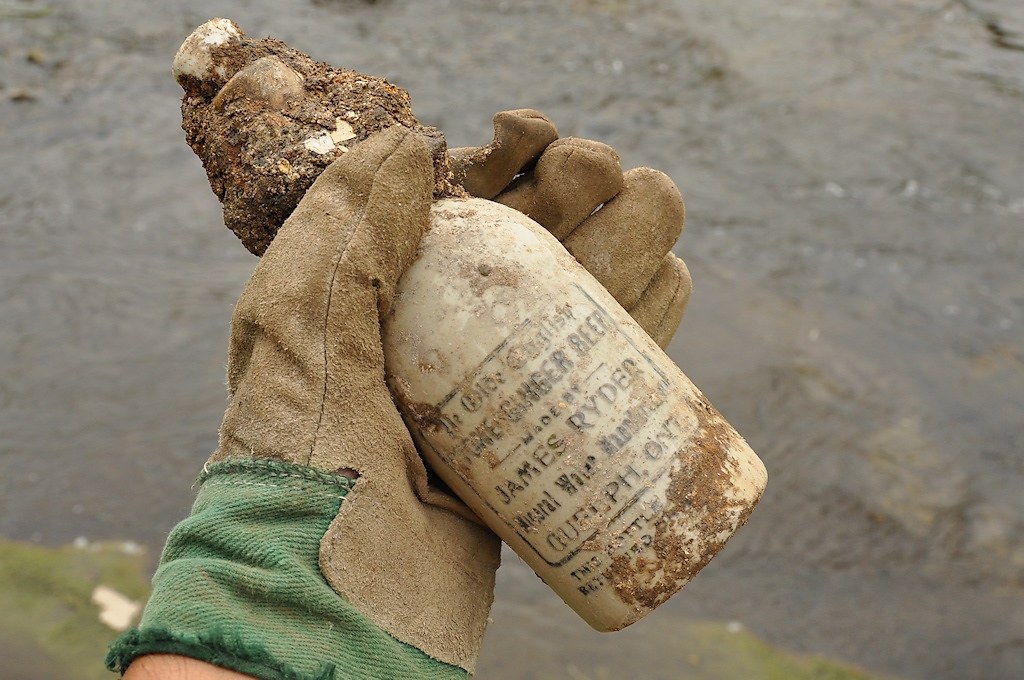
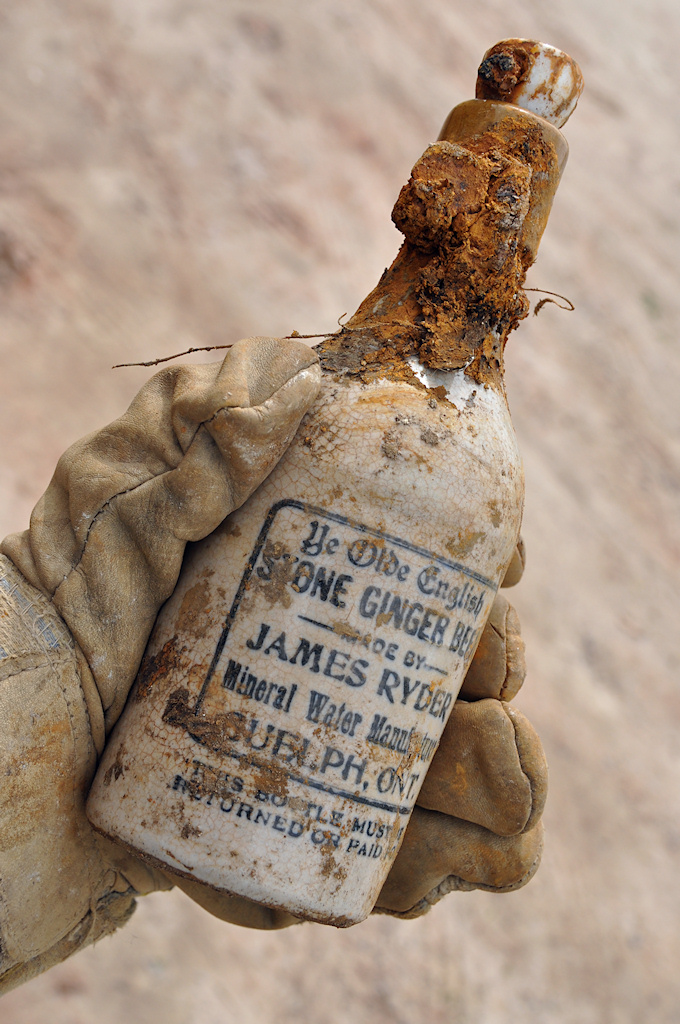
When I saw Ace post this image of a James Ryder Ginger Beer from Guelph on Flickr, I knew there had to be a backstory, and so I asked him for more narrative in the comments.  Two weeks later, on a cold Sunday afternoon in May 2016, Ace replied to my request in an email.

Antique Stonewear Ginger Beer Bottle - James Ryder, Guelph,
But first, on his original Flickr post, Ace wrote, "always nice when you can find an old ginger beer bottle from your hometown.
____Ye Olde English____
 ___Stone Ginger Beer___ 
_______Made By_______ 
_____James Ryder______ 
Mineral Water Manufacturer 
____Guelph, Ontario_____ 
___This Bottle Must Be___ 
__Returned Or Paid For__

Category: 4 Rare "

The same James Ryder Ginger Beer bottle is in the Guelph Museum and is described in their website archives as "Stoneware ginger beer bottle. Glazed, off-white and gold neck, black label, ceramic stopper with rubber ring attached to neck by wire. "James Ryder, Mineral Water Manufacturer". Stamped: "Ye Olde English Stone Ginger Beer". They do not attempt to date the piece.

Also present in the Guelph Museum are two clear glass bottles that hold 8 fluid ounces each. One is embossed "Ryder's High Class Mineral Waters, GUELPH" on the front. It also has an image of "Conveyor Belt with a Wheel". Bottle made in a mold between the years 1915 to 1925.  The other clear glass bottle is also embossed with the same lettering but features a picture of "a well with a pulley system".

While scouring the online archives in Guelph for anything know about James Ryder, I did discover his name among the membership rolls in the Masonic Lodge and we know he was a benefactor or at least had some affiliation with the Salvation Army, cause his name is in a booklet from the 1920s. Perhaps I could have found out more. Maybe a reader will email me more information?

Ace emailed me this morning and wrote,

Here's the story for the James Ryder bottle, I was walking by a Guelph construction site and noticed some bottles lying around and one of the construction workers didn't seem to mind if I stopped by after hours to look around. When I came back in the evening I noticed the hole the backhoe had been digging earlier was mostly filled in again but there was one spot I could still dig myself. I dug up many junk bottles and was about to give up when I noticed a white stopper sticking out the side of the hill, I gently poked at it and it fell out and there appeared to be a top of a ginger beer bottle lying its side but I figured it probably wasn't intact so I didn't get my hopes up. I carefully dug it out and turned it over and to my surprise it was a James Ryder Ginger Beer bottle from Guelph and in one piece. I continued to dig a little longer for more good stuff but got nothing but junk. The hole has now been filled in again so I'm lucky to have at least found one good bottle. - Ace from Guelph