Monday, April 20, 2015

2015 Toronto Bottle Show, Sunday April 19th at Pickering Recreation Complex

This 21st annual Toronto Bottle Show and Sale is a monumental undertaking by the Four Seasons Bottle Collectors Club and was held this year at the Pickering Recreation Complex located at 1867 Valley Farm Rd.. Much better than previous incarnations, this year's bottle show was very well attended by the public.

Up from his home near Brighton Ontario, Jason Garrison and his buddy Jim took the time to ponder the piles of glass in Pickering last Sunday morning. These two collectors were among five hundred other antiques dealers, pickers and dumpdiggers who made the drive out to the show.

Doors opened at 9am and the cozy venue was absolutely jammed until 1pm which is when I went about interviewing the media-friendly dealers in the room. I talked to dozens of people, and snapped so many pictures my camera battery died... It was the best hour of my weekend.
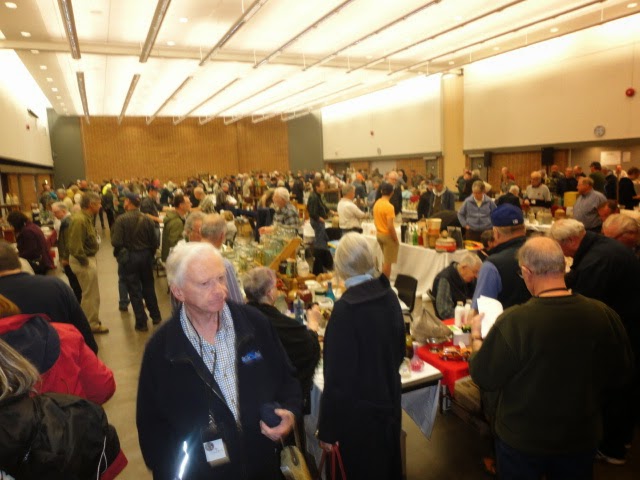
Expertly conducted by Four Seasons Bottle Collectors members the show went off without a hitch.

Gary Spicer was the first person I assailed and he spoke to me in between sales. See below I got real close on Gary as he held up a Starr Brothers squat soda from Brockville Ontario that was made and filled with carbonated beverage between the years1860 to 1876.

Gary was asking $225 for this rare ad highly coveted soda bottle.

Gary Spicer has been coming to the show for decades as dealer and consumer;  he's been collecting antique bottles for forty four years and spend twenty years as a scuba diver, which is a great way to build a big collection. Gary uses the annual show to clear out the clutter from his displays at home and make a few extra bucks to put toward other projects. He was selling some lovely sodas, a few medicines, and while I watched he sold two rare milk bottles to another collector, also from Eastern Ontario.


In very good condition, his Starr bros soda bottle still bears the rusty remains of its 1860s era, primitive cork and wire closure.


Reids Dairy, Tim Maitland, Jim Maitland


Tim Maitland beside his father Jim Maitland holds what he calls a 'transition milk bottle' that was made in the late 1930s or early 1940s and has both ACL (Applied Coloured Label) and is embossed with the words Reid's Dairy right in the glass. And it even has a rear panel with a nurse's face extolling the health virtues of drinking cow's milk. This branding combination makes the bottle extremely collectible, and a real bargain at $325.


GUARD YOUR HEALTH / THERE IS NO SUBSTITUTE FOR MILK

Here's a lovely soda from Orangevillo Ontario.


Down the aisle were a couple more diehard diggers, Barret Nicpon (with banana) and Chris Minicola.  Chris collects insulators and bottles from Peterborough and Lindsay areas, and Barrett collects bottles from London and Strathroy Ontario in addition to insulators.

Chris wanted me to tell you all that if you wanted to find out more about insulators, the 17th annual Perth insulator show and sale is being held on Saturday, May 2nd from 10 to 2:00 at the Lions Hall at the Perth Fairgrounds (Halton and Arthur streets) . Admission is free and there are usually about twenty tables full of insulators for sale or trade along with various displays.

Barrett Nicpon holds up his Canicula brand embalming fluid bottle, which is a 'mortuary antique' and quite desirable in that niche. The 'pleasant smelling' contents are still in the bottle. $24


Canicula Concentrated Embalming Fluid. Canicula Chemical Co. Toronto On. This is also known a 'hardening fluid' in the funeral trade.  Great label.


John Goodyear holds up a lovely 1850s era salt-glazed stoneware finger jug, made for A FOSTER / WINE AND SPIRITS MRCHANT / KINGSTON that he'd purchased earlier that day from another dealer at the show.  Because he was the jug's buyer and not its seller he declined to give price information, but let me know he got a great deal and was very happy.


Abraham Foster was a grocer who commissioned stoneware to serve his wine and spirits trade in Kingston Upper Canada from the 1840's to early 1860s. He rented 101 Princess St and appears in this archival record reprinted in the Kingston Whig Standard. "101 Princess St. Built in 1841 by Captain George Smith and let to grocer Abraham Foster."


John Goodyear is a experienced diver and veteran dumpdigger who has personally recovered much of the stuff on display. He collects bottles and stoneware from Kingston and surrounding area towns, including Preston, Cornwall and Brockville. These are his 'spare treasures', and he reports selling soda siphons and quarter gallon jugs before I arrived at his table, and doing rather well, enjoying the curious crowd.

John's 2015 table wares were festooned by this green glazed Redware architectural finial.


This custom made cone-shaped tip once adorned the peak of an ornate building, or perhaps the posts of an imposing gate or some equally ostentatious structure that needed to make a point.  John was asking $425 for this very unique piece.

David Moncrief is the grandson of John Earl Moncrief, the much celebrated proprietor of Moncrief Dairy in Peterborough and he smiles politely as I make him hold a creamer from the 1940s uncomfortably close to his face. David tells me that before refrigeration there was a local dairy every  few miles as the law forbade long distance transport of raw milk.


David had a steep price tag of $425 attached to the piece because he didn't really want to sell it and was rather hoping to find the perfect trade.  He brought his son to the show and the boy was so excited he could barely contain himself.


Jamie McDougall behind a wall of antique bottles, perches over his pint sized poisons.


When I asked Jamie what he wanted to show me he smiled and pointed to a nondescript row of transparent medicines at the bottom of the white display case - Hudson Bay druggist bottles. The small vessels were all various shades of window purple, and Jamie says '...its a very difficult collection to put together.'  Its also a difficult collection to photograph.

Terry Matz is Canada's foremost torpedo bottle lover, collector and expert appraiser. Every year he brings a couple mysteries to the show to share with his friends and poll the public for clues. This year he brought a pair of shoes that are also flasks. The Mrs Two shoe flasks are a matching pair with laces on the right and left respectively.

The glaze is not Rockingham, its Bennington.  I asked Terry if these were 'one of a kind', and he said they were as far as he knew, and when I challenged that perhaps they would be more valuable if they were a more common collectible, and he replied no, that's not the case. As unique art pieces they are worth far more than if they were mass produced as part of a production line.


The date 1869 is the biggest clue, and Mrs Two was probably a well to do lady in society and worthy of two shoes full of gin.

I also have to include another lovely pottery piece Terry Matz was selling, a pancake batter jug. Sadly my automatic camera focused on the sign in the background but you get the idea - its like a tea kettle but large with a much bigger spout capable of passing blueberries in batter.
 Its probably French Canadian - on one side of the jug a man is drinking beer and smoking a pipe,
 while on the other side, an older lady is weeping.


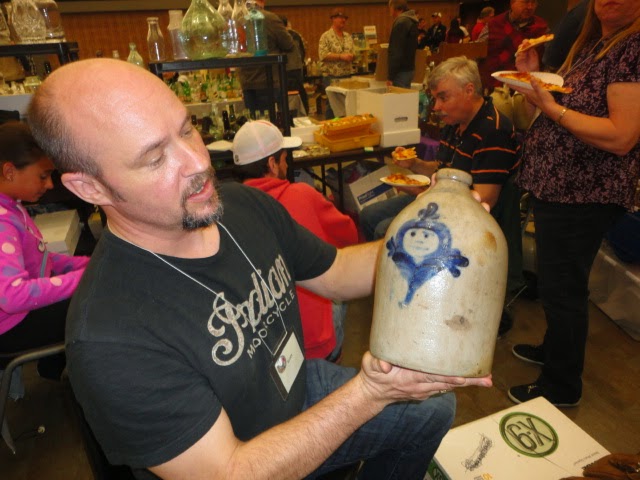
Scott Wallace with a rare treasure. This stoneware jug was made for John Morton in Brantford Ontario proprietor of Morton & Company (1849 – 1856).  What's unusual is the face in the decoration. These jugs have flowers, birds and animals but almost never have have face in the cobalt blue glaze that adorn their sides. The jug is in great condition and will be sold in the upcoming Maple Leaf Auctions for antique bottles and early Canadian pottery. 


Bob Harris can be seen eating pizza with his daughter in the background, and when I got around to interviewing him he held up a plastic tool box filled with period fishing tackle. He told the familiar story of finding a an old fishing tackle box rusted beyond repair but filled with mint condition fishing lures sinkers and bobbers many still in their original boxes.
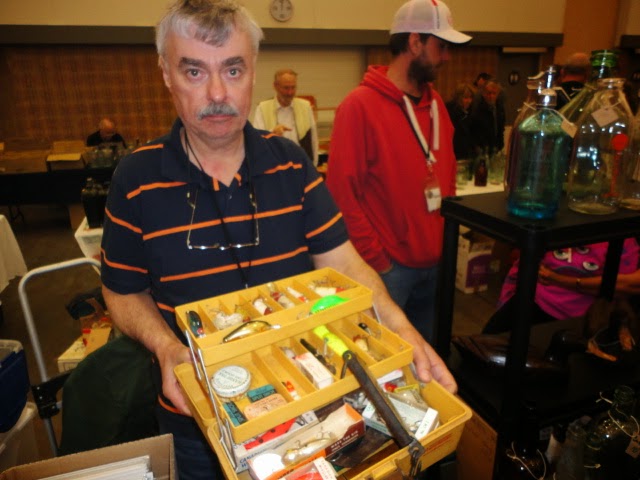
Period fishing tackle is a great thing to bring to a bottle show ... or is it? 

Tom Holbrook and Ross Wainscott had some lovely cobalt blue apothecary bottles and medical dispenser vessels and druggist bottles. 
This is a rare gem. The four inch square sided 'hospital bottle' has a faded paper label, currently being protected under saran wrap, that indicates it once held five yards of aseptic medical gauze. This bottle was made by the Consolidated Fruit Jar Company in New Brunswick New Jersey for the company that became Johnson and Johnson in New York. This jar evidences the spread of knowledge and the war against germs in the 1890s.  People realized that hospital bandages need to be kept clean and dry and free of infection. The price for this rare piece of medical history is $1000.


Here's a bad photo of Scott Jordan, a well respected collector from Ottawa.


Prompted by my curiosity he quietly brought forth his most expensive treasure which is a square sided four panel medicine bottle ..

I didn't record its name .. it seems.. but the side of the bottle is embossed, 

Toronto C.W.

C.W. of course means 'Canada West' which are magic words to Canadian bottle collectors.

I will leave a blank spot here which I may fill with more information later.. 

The bottle takes center stage in his crowded display case.


John Knight attracts beer bottle collectors and soda bottle collectors by offering them free bottle caps to match their collectibles at home. He has over a hundred or more different bottlers here, and its enough to stop most folks who crowd around looking for their missing crown top sodas and beer bottle caps for the bottles they have a home without such closures. Its a gimmick.
Here's a crummy photo of John Knight's best bottle, a green glass soda embossed COPP / GUELPH for which he's asking $2000.
This lovely pontiled soda was made between 1857 and 1862 and is in great condition today - no chips or scuffs. You can see a terrific photo of a damaged COPP soda bottle that was donated to the civic museum in Guelph and read the comments - its worth a smile.


Here's a lovely candy dish with a artful decoration made to commemorate the arrival of the steam ship in Little Current, Ont. which is the north bridge port on Manitoulin Island in Lake Huron.


The Toronto Bottle Show imparts the joy of hunting and finding cool stuff as dumpdiggers hunt through boxes and table displays to find what they need at home.
The veteran collectors gather and chat about their antiques and hint at upcoming trips and bottle digging expeditions to find and dig treasure filled holes in historic properties. This is big leagues show and tell, and I feel privileged to walk among these folks and relate their passion for the past here on this blog.
 The Toronto Bottle Show puts a wealth of information on display.

Friday, March 20, 2015

Forward Condo Excavator Finds Century Old Soda Bottles at Fort York Blvd and Queen's Wharf

The excavation site of the Forward and Newton condominiums, on the S.E. corner of Bathurst and Fort York Blvd. in downtown Toronto, has exposed the site of what was once the Through Freight & Passenger Depo of the O.S. & H.R. Railway (the Ontario Simcoe and Huron Railway circa 1870), and here, on the threshold of this hole in time, I encountered a professional excavator with small treasures that were made and sold over one hundred and thirty years ago.

Professional excavators are Dumpdiggers too, and they're always curious about what they find deep underground. So when i asked to come take a look, they were more than happy to show off their finds and discuss the history of the location.


Here's Saul Beringer with an Alex Burns / Toronto aqua blob top soda.  It would have had a cork stopper. The "Blob Top" closure was stronger and was often selected by early carbonated beverage makers because it could better withstand the corking process at the bottling plant. The bottom is embossed with the word "B".  Traditionally bottles with rounded bottoms are referred to as Ballast Bottles, but I'm not sure that would apply in this case.  The specimen has no cracks or chips

The bottle was recovered by the shovel man who works in tandem with the Anpro backhoe operator and they fetch what they can from the gaping maw of their all consuming machine that must move so many tonnes of earth per day to remain on schedule.
They have a system. But honestly, between the two of them, they probably only recover about one percent of the bottles in the pit....
 
This is a truly lovely specimen. You can see a clean Alex Burns Belfast Ginger Ale on the Canadian Bottle Lovers page.
ALEX BURNS / TORONTO
BELFAST GINGER ALE

Who Was Alex Burns And Why Was His Bottle Found Here?

We know from old municipal records that Alexander Burns broke off his partnership with his brother William Burns of A & W Burns Beaver Soda Water Works in Toronto in late 1877. He went solo in the soda water and ginger ale business from 1878 to 1882.

Alexander Burns made Belfast Ginger Ale which was a particular recipe, not too sweet, and not fermented, so consequently its non alcoholic. It's a sparkling and clear beverage that has a most agreeable odor, and is free from any intoxicating qualities. Many early ginger ale makers professed its medical properties.  The exact composition of the 'Belfast' blend is not known, but it is generally understood that ginger, capsaicin and citric acid, especially lime juice are the chief flavoring ingredients. The addition of lime juice to ginger ale imparts a rich fruity quality acquired in no other way. A bottle of Belfast Ginger Ale probably sold for a penny or two on the steamship in the 1880s.

A mint condition 130yr old Alex Burns Belfast Ginger ale bottle sells anywhere from $30 to $60 today. The bottle was most likely made in the USA because it's so similar to others made there in this same shape, size and glass composition. However the word Toronto embossed on its side ensures there will always be a place for this specimen in Canadian antique soda bottle collections.

This bottle was not found at the very bottom of the pit. It was found above the docks that are now visible in the dig site, and above the murky water we can now see at the very bottom (but the excavators will go much deeper yet). That's because the bottle was used and discarded in the 1880s, and not the 1840s or 1850s when the first docks were buried to make way for the railroad and bigger ships. (in the late 1840s).  According to Abel DaSilva, who is friends with  the backhoe operator, the colored bottles, and the really precious Canada West bottles from the 1850s and 1860s are found in the muck below the docks (on what was once the lake bottom). The passenger ships docked there, and it was common to clean the ships while they tied up in the harbour. The sweepers always dumped the passenger's garbage overboard.

That means there's lots of older stuff down there... waiting to be uncovered. 

Below is a map from the 1850s (?) and here you can see its just one pier to the right of the Queens Wharf below the train station.
Queens Wharf Station was a railroad stop and steamship ferry port. Most of this is now buried ten feet of more under the pavement of Bathurst St.today...  I can only imagine that Fleet St got its name because a fleet of some sort was literally parked there at one time, docked along the military pier in the harbour.

1857 Canada West map of the city shows the Depot Grounds of the Ontario and Huron Railway


Below you can see the railway had just one short stocky pier in 1857.  The Queen's Wharf was presumably where the business of government and the military docked.  

The backhoe operator and other experts believe this hole in the ground is directly above the Through Freight and Passenger Depot of the O.S & HR Railway Wharf which you can see on the bottom right of the 1857 map above. Click these pictures - they expand.

This picture of the Toronto Harbour also dates from the 1850s, and shows a busy port with good rail connections. You can clearly see the old fort, and from that find the T shaped Queens Wharf (now underneath Bathurst St.) and right beside it, the busy O.S.and H.R. railway wharf is on the bottom right hand corner of the first plate (in the middle of the picture).


The Ontario, Simcoe and Huron Railway

In July 1849, the Toronto, Simcoe & Lake Huron Union Railroad was founded by Frederick Chase Capreol and Charles Albert Berczy. An act of Parliament, known as the Guarantee Act helped finance construction of the railway through the sale of bonds, with the interest guaranteed by the colonial government. But the financing was anything but stable, and there were a few sensational stories of fraud and stock 'bubbles bursting' in the newspapers of the time.

1853, May 16 - The first train in Ontario runs between Toronto and Aurora on the Ontario Simcoe and Huron Railroad Union Company line. The first train was driven by W.T. Hackett who also took the first locomotive into Kansas City. Below is a picture of Engine #2, The Toronto. 


The railway was originally known as the Ontario, Simcoe and Huron, referring to the three lakes the railway connected. The aim was to provide a portage route from the upper Great Lakes at Collingwood to Toronto, where a variety of other shipping routes were available.

The OS&HR Railway name was changed to Northern Railway of Canada on August 16, 1858 and it became part of the Northern and Northwestern Railway on June 6, 1879, (its now part of Canadian National Railway or CNR). Financial difficulties and a government bailout led to a reorganization of the company as the Northern Railway of Canada in 1859. 


These pictures expand! Click the pic to see the busy rail yard and port system of the early 1860s


The Port of Toronto is the gateway to Ontario; fast forward twenty more years and we can see how the port and the railway grows as business and commerce expands on the Canadian frontier. In 1887, the Grand Trunk Railway (GTR) gained a controlling interest, and the takeover was formalized in January 1888. Now there are four piers, each connected to a railway line.


I believe the picture above is from 1884, and now you can see it gets really busy in the bottom left corner and indeed all across the lake shore. This is when Alexander Burns was selling his pop.


Look at the intricate transite connections with their piers in 1894 above. You can see the railway yard to the right of the Queens Wharf has four piers now.

Here are steamers docking at the railway piers in 1913. Look at the smokestacks and industry in this photo and imagine all the garbage that went over the side of these boats with little or no concern for the environment. Their primitive glassware, medicines, sodas, beers, and sealer jars, whisky jugs, crocks, clay pipes, dental tooth powder jars, ceramic moustach grease containers -their most industrial garbage are among our most coveted and collectible treasures today.

 Fast forward one hundred years from this exact same spot, looking in the same direction...


Behold we see the wooden piers where the steamers docked to unload small wooden boxes filled with goods from other parts of the British Empire and America cities south of the Great Lakes.

Like Brigadoon, the Toronto waterfront is exposed to daylight again. But not for long; in the background you can see the Condos are marching 'Forward'

Forward is the name of the condominium building that will stand here in a few more years time.

Forward Condos, joins Newton Condos at the west of Concord CityPlace. The 30 and 18-storey towers are designed by Page + Steele / IBI Group Architects.

Wednesday, March 18, 2015

Changing Fashion For Raccoon Fur – Sell Raccoon Coats Online Today

Raccoon fur is back in fashion... in China.  So it behooves Dumpdiggers and antiques pickers to keep a sharp eye out for good quality coats in Canadian thrift stores to sell for more money online. Use Alibaba and eBay to sell this stock now, while its red hot..


Antique raccoon fur coats can be found in just about every thrift store in Toronto because they’ve been donated by society ladies on mass for the last twenty years. In the late nineteen eighties shifting consumer tastes and catchy animal rights slogans including, “I’d rather go naked than wear fur” killed the market in Europe and North America.  Dumpdiggers has reported before how the fur trade is a renewable resource and the unemployment the fashion shift caused severely impacted Native people in remote areas of northern Canada.

But a recent story in the National Post, suggests that Chinese industrialists are buying fur for fashion. They seek polar bear skins rugs and wall mounts, but also fox, mink, rabbit and even raccoon fur for fashion accessories, ornaments and coats. “The Chinese appetite for furry Canadian critters coats has single-handedly revived an industry that, in the North American and European spheres, was left for road kill more than 20 years ago.” 

Antique Raccoon Fur Coats

The fur of raccoons has always been used for clothing, especially for coats and coonskin caps. At present, it is still the material used for the inaccurately named "sealskin" cap worn by the Royal Fusiliers of Great Britain.

Historically, Native American tribes not only used the fur for winter clothing, but also used the Raccoon tails for ornament. The famous Sioux leader Spotted Tail took his name from a raccoon skin hat with the tail attached he acquired from a fur trader. And right up until the 19th century, coonskins served as means of payment in many southern States.

When the fur trade ended in the 1800s so too did the demand for Raccoon, but certain inventions and fashion whims of the next century increased demand again. The invention of the automobile increased the demand for raccoon fur when ‘automobile coats’ became popular after the turn of the 20th century. To the right is a vintage 'automobile coat' made out of raccoon fur (1906, U.S.)

In the 1920s, another fashion fad emerged among young people, when wearing a raccoon coat like the one in the picture was regarded as status symbol among college students.

Attempts to breed raccoons in fur farms in the 1920s and 1930s in North America and Europe were ultimately unprofitable, and farming was abandoned after prices for long-haired pelts dropped in the 1940s.

Fur industry experts write that to satisfy fashion’s demand for raccoon fur, the annual seasonal hunt in the 1940s  reached about one million animals (across the entire United States) and was double that in the nineteen sixties.  It lagged for a time in the early fifties but was revived in part by the broadcast of three television episodes about the frontiersman Davy Crockett and the film Davy Crockett, King of the Wild Frontier in 1954 and 1955 which led to a high demand for coonskin caps in the United States.

In 1982, the average raccoon pelt sold for $20.  As of 1987, the raccoon was identified as the most important wild fur bearing animal in North America in terms of revenue. 

There's a 100,000 Raccoons living 'wild' in Toronto

A 2013 BlogTo Article about raccoons in Toronto estimates this wild animal's native population somewhere in the range of 100,000 to 200,000 - that's as many as 12  per square kilometer. Imagine then sleeping in garages, fighting, and poking through garbage. Now consider that each pelt is worth $20 each, and the price is climbing. How much longer will we have a raccoon problem in Toronto?

Raccoon fur coats sell for about $500 USD each on Alibaba, and the price rises in accordance with the quality, brand and particular style of the garment.

Derick McChesney of SWAT Wildlife runs a raccoon removal service in Toronto, and reports that there is no market for raccoon fur domestically, or for the animals dead or alive. He is a popular and trusted expert on raccoon removal in Toronto on Homestars and reports, "I have never been contacted by a coat maker seeking raccoon fur, not yet anyway". And he quickly adds that he's mandated by the provincial and municipal conservation authorities to release what he catches back into the wild, inside the city. He's not aware of any fur farms.  His Nuisance Animals in Toronto HubPage shows stats that his firm collects over 950 raccoons each year.

Interesting fact, most urban raccoons die from a viral disease called 'Distemper' that affects a wide variety of other animal families, including domestic and wild species of dogs, coyotes, foxes, pandas, wolves, ferrets, skunks, and large cats.

Friday, December 12, 2014

Shasha Bread Company Kitchenware Antiques

CEO Shaun Navazesh keeps ancient bread making relics on display at Shasha Bread Company headquarters in Etobicoke Ontario.

ShaSha Shaun Navazesh makes Bread from Sprouted Grains at his Bakery in Etobicoke.
Photo: Shasha Shaun Navazesh

In December 2014 Shasha Shaun Navazesh gave me a tour of his organic food store and bakery in Etobicoke Ontario to show me how he does things differently.

We began in the Shasha Bread Co Sprouted Grains dept of his large bakery facility. ShaSha Bread Co.has been sprouting organic, vegan and non-genetically modified grains since 1999. I detailed the whole process of how Shasha makes flour and bread with sprouted grains in my article on Toronto is Awesome magazine, and wrote about the science of making baking bread with sprouted grains on Fuel Ghoul. At the end of tour, Shaun gave me a loaf of Ezekiel bread and walked me out past his mini- museum and store of antique bread making items.
A corn broom and cookie rolling pins in a well crafted wrought iron flat pan.  These are African cooking implements. The corn broom could be the whisk the breadmaker uses to gather the flour dust from the common trough in which the grain was ground.
 Here is Shaun Navazesh holding such a cooking trough. This is the whole kitchen for a family in an African village - every meal is prepared in here and flour was worked into bread.
Click image for larger version. 

Name: 15761203780_36a5a456ef_z.jpg 
Views: 5 
Size: 68.9 KB 
ID: 1090626

Shasha also has Victorian Era Chocolate Easter Egg Molds

Click image for larger version. 

Name: 15946543951_f72bb56a34_z.jpg 
Views: 5 
Size: 63.7 KB 
ID: 1090624Easter eggs are a very old Christian tradition. The Easter egg symbolizes the empty tomb of Jesus. To ancient man the egg was a miracle. A chicken egg appears to be dead, like a stone, yet a living bird hatches from inside the rock. Similarly, the Easter egg, for Christians, is a reminder that Jesus also rose from such a grave, and that those who believe will also experience eternal life. This mold appears to be made of a tin and such molds were used for such confectioneries. Madelines, teacakes, and petit fours were all baked in small, stamped-tin “patty pans,”

This mold is for large chicken egg sized chocolate eggs. This relatively lightweight tin mold snaps tight to keep heat in and bake the oval objects hard with a smooth finish on the surface that happens naturally when the chocolate cools *in some processes with some types of chocolate. This is most definitely a sturdy, well-built, professional mold. Hinged on one side, it has hinges and a clapse on other side to hold it closed.
Inside, you will see that the tops of each egg have slightly different shapes which is a sure sign this piece is handmade by smiths pressing the metal. Egg mold will make four eggs at once. These small treasures and more are on display in the office of Shasha's bakery in Etobicoke. You can find out even more about the place, people and products and read about how Shasha bakes bread with sprouted grains on Smart Canucks. 

Friday, November 21, 2014

A History of Making Custom Cardboard Boxes at Colt Paper

Colt Paper started back in 1935 when Sidney Colt realized that there was a need for boxes in Toronto.  He began buying and selling used boxes, doing business under the name S. Colt & Sons.

For many years Sidney bought and sold cardboard boxes as enterprising wheeler dealer; his customers were store merchants and captains of industry all over the city. It was one of Toronto's earliest cardboard recycling programs.

Even today cardboard can be collected and sold to recyclers for profit.  There's money in that.  Most types of "cardboard" are recyclable, but laminates, wax coated, or boxes treated for wet-strength are more difficult to recycle. Clean cardboard, by which we mean cardboard that has not been subject to chemical coatings is usually worth recovering, although often the difference between the value it realizes and the cost of recovery is marginal. Cardboard can be recycled industrially, or used for other purposes. For example its often used as building insulation, and damaged cardboard can be shredded for animal bedding.

In the 1950’s, S. Colt & Sons started ordering new boxes direct from Canadian cardboard manufacturers. 

By the 1960’s, Colt Carton Service had become a manufacturer of corrugated boxes and pads in its own right. This was a big step forward - it required a location where machines could be set up to fold and adhere paper which came on thick reels. It required shipping and printing, cutting and waxing, design and marketing, payroll etc. It was a full fledged factory at 151 Sterling Rd.

Manufacturing cardboard boxes in Toronto followed a process that was started almost one hundred years earlier called 'pleating paper'. The process was patented in England in 1856, and the pleated paper used as a liner for tall hats, but the corrugated box board as we know it was not patented until December 20, 1871. The patent was issued to Albert Jones of New York City for single-sided (single-face) corrugated board.

Jones used the corrugated board for wrapping bottles and glass lantern chimneys and you can still get one sided bendable corrugated paper board for similar fragile object insulation purposes today. The first machine for producing large quantities of this type of corrugated paper material was built in 1874 by G. Smyth, and also in 1874 Oliver Long improved Jones' design by inventing corrugated board with liner sheets on both sides, thereby inventing a more rigid 'corrugated cardboard' as it came to be known in modern times.

This is Sterling Rd looking north from Dundas St in the early 1920s. This is the industrial park beside the railroad tracks. Colt Paper set up their factory here in the 1960s and they have been making and selling custom cardboard boxes ever since.
  
The corrugated box was initially only used for packaging glass and pottery containers. But in the mid-1950s, cardboard fruit boxes enabled fresh produce to be brought from the farm to the urban grocer without bruising, and quickly thereafter the demand for cardboard became industry - wide, and Colt Paper was in the thick of it!

In the 1970s and 80s, Sidney’s son Neil helped expand the company to include various products for shipping including bubble wrap, poster tubes, poly bags, packing peanuts, wooden crates, poly foam.

Neil's daughter Sari is now part of the team as well. Colt Paper has been a proud part of the Junction Triangle/Sterling Road community since the 1960’s.  Rob wrote an exploration of Colt Paper for SmartCanucks forum that goes inside and looks around the business as it exists today.

The area has changed from industrial park to an artsy entrepreneurial zone. Colt Paper is committed to supporting their local vendors, believing the communities are richer when we buy from each other.

http://www.coltpaper.comAll of the corrugated products are manufactured locally, and they were among the first to switch to starch based enviro friendly packing peanuts.   Colt Paper supports various charities, including United Way, and Sleeping Children Around the World.

Colt Paper specializes in custom manufacturing plain and printed boxes.  Colt excels in meeting the needs of entrepreneurs who want to brand themselves without committing to large quantities.

Special thanks to, Colt Paper - 151 Sterling Rd. Toronto Ontario Canada  M6R 2B2
416 - 535 - 7234   or call toll free,  1- 800 - 249 - 2658

Saturday, September 27, 2014

Dentist Acid Can for Recovering Gold Fillings Found in Markham Ontario

The old Town of Markham Ontario has lots of history and contains many venerated historians, not the least of which is Carl Parsons, seen here at the 2012 Toronto bottle show with a great big steel can that he brought to the show to challenge the other collectors' knowledge and possibly learn a thing or two himself from their vast collective experience.  That's what the annual bottle show is all about...

The can is about three feet tall and slightly pear shaped with a solid ring about the bottom which supports a round interior bottom. .. perfect for mashing..This is an important clue to what the can could be used for.

Another clue is the thick heavy lid, it's solid iron that weighs about ten pounds.  And look at the handles on the side of the pail - they are significant too...

Later on that summer, I rented the big heavy can from Carl for a week for $100 and drove to Markham to pick it up and back again to deliver it safe.. I used it on camera as a prop in a demo for a TV show about antiques called Antique Tac Toe that we were 'pitching' the CBC. More on that later,

Carl had everyone stumped at the bottle show about what the can could possibly be used for..?  and when he told us we were flabbergasted .

This 'acid can' was used one hundred years ago by a Markham dentist for acid reduction of teeth to liberate gold fillings.

That's why the lid is so heavy! And the can is so tall and acts like a stack to contain the heavy fumes that issue from the brew. At the bottom of the acid mash are the teeth that the dentist has extracted and no doubt given some credit for? to the patient's who gave up their rotten molars filled with gold.

At the end of the month he would carry the can outside and dump out the acid and hopefully find lots of shiny gold bits on the ground with little or no trace of the original teeth.

Last century's dentists used gold for teeth fillings because the metal doesn't decay or breakdown in the mouth. 

Gold has been used since prehistory for filling cavities in teeth. Several dental historians have written about the history of gold in dentistry. The subject discussion usually begins with a reference to the discovery of two molar teeth held together by a gold wire, found in a burial shaft at Giza, along with the articles that are believed to have dated from late 4th or 5th Egyptian dynasty in the third millennium B.C. (the four thousand year old gold wired molars have now been placed in Pelizaeus Museum in Hildesheim). And so its logical to assume that gold has been used in dentistry ever since.

We know for sure that gold leaf was first used to fill teeth in 1483 by Giovanni d’Arcoli, but his method was by all accounts rather tedious, and much too expensive for the average person, or even upper middle class people. Only the wealthiest class could afford to have their teeth repaired with gold in his shop.

Fast forward to North America, throughout the 1800s, where gold was by far the most popular choice for teeth fillings. The “cohesive gold foil technique” that was perfected in 1855 made gold fillings much less expensive than previous gold leaf applications, and made restoration of decayed teeth a real option for a wider range of consumers. By the 1920's its estimated the North Americans dental industry consumed 80 tons of gold per annum. And then other alternatives began to appeared in the marketplace. In some cultures, gold teeth and gold teeth caps are still a sign of wealth or a means of protecting fortunes. Some of that wealth can be recovered over the life of the patient, and that requires a big metal can filled with a corrosive agent to break down the teeth and free up the precious metals.

The science of making false teeth

Over time many substances have been used to fill and simulate our white enamel teeth. There's a common myth that George Washington had wooden teeth that were painted white? This has been denied as false, but you know I bet its true. I bet at one time he did have a set of wooden teeth lying around in a drawer somewhere. It's reported too that he had a set of teeth custom fit some made out of hippopotamus ivory, and some say he had teeth made from other human teeth using complex metal fasteners. We know he got his first set of false teeth before the Revolutionary War, and may have also undergone the infamous “tooth transplantation” procedure, perhaps even using teeth purchased from his own slaves, in the mid-1780s with the help of his personal dentist and friend, Jean-Pierre Le Mayeur.