The title says it all...
For many years I've heard about avaricious antiques collectors who stand at the fence out front of downtown Toronto excavation sites and arrange to buy found objects from the workers. The crafty collector infuses the excavators with a duty to save their Canadian heritage, just by talking about the old bottles passionately and teaching them some history. The friendly merchant who makes lunchtime visits to the dig site sets a policy and offers to buy everything found intact for $5 a bottle, and $10 for all pottery.
This was a recipe for getting rich in the 1980s when bottle prices were high and the dumps were the oldest. But then a lot of tall buildings were built along the lake shore in the 1990s, and even more in the 2000s, and bottle prices plummeted with every excavation. Also, the site workers themselves got smarter, and now they're bottle collectors too.
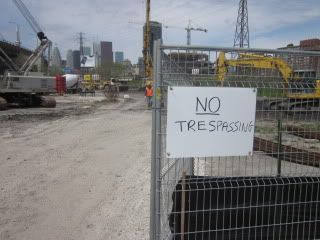
Here I am making 'first contact' with Shawn the Shovel Man at Cherry St. and Lakeshore.


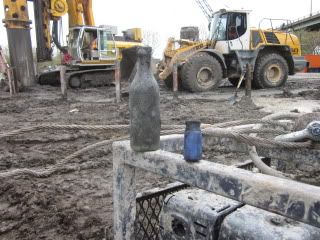
The guys on the boring machines at Cherry and Lakeshore are finding some interesting things with every corkscrew down into the mud.
There's a lot of development happening in the West Donlands. There are plenty of shovels in the ground and old Toronto bottles are popping up everywhere.
Let's look at the future of this place. This is 2015

Athletes Village - Pan American Games Park - Lower Donlands. On November 6th 2009, it was announced that Toronto had won the 2015 Pan Am Games, on the first ballot.
Now journey back to 1793, to the shores of muddy york.

Archeologists are busy digging up the foundations of old buildings as they search for history ahead of steam shovels developing this quarter for the Pan Am games. Here's a
discussion on Urban Toronto asking and telling about archeologists in the Old City - the oldest part of Toronto. Click the map - the picture expands and you can see right where Toronto started. This is the 1793 Map of the Toronto Harbour made by Joseph Bouchette.
The Lower Donlands, just east of The Distillery District, is one of the oldest parts of Toronto. It’s been neglected for years and is only now undergoing some long overdue development.
Earlier this year, I posted about a
lost creek that became a Toronto city dump in the late 1880s, at King and River Sts. Streetcar Developments condo buildings have some special engineering to suck up water at the base of the northwest wall and channel it through pipes to return it to the municipal sewer system drainage on the south side of the structure. They had to do this or the underground parking lot would flood because of a spring to the north that made the original lost creek which, previously, ran into the Don River. This natural water system was buried in garbage in the late 1880s. The excavation workers at that site carried away boxes full of early pottery and glass bottles while the machines were digging the riverbed. The one picture of 1870s era stoneware beers that I obtained for the blog was only a small portion of the hoard that sprung forth, only to be reburied in dump trucks or snatched away by staff.
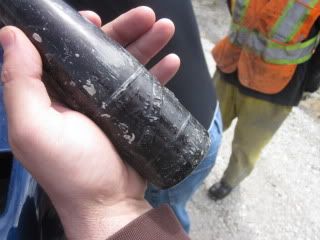
Over the years the luckiest and friendliest excavation site workers have become well paid ‘inside men', and profit by selling or trading what they find in the ground. Most just liquidate for cash, but some of these guys amass large collections of museum quality artifacts. At Cherry Street and Lakeshore the boys are keen to find things, but unfortunately there's a lot of broken material due to the corkscrew boring mechanism...
Working right on top of the Martin Goodman bike path south of the railroad bridge, and in the shadow of the Gardiner Expressway overhead, these yellow clad men are the most unlikely time travelers you'll ever meet, but with every corkscrew full of earth they dredge up from twenty feet down, they voyage back to the shoreline of the earliest British settlement.

On May 18th I was passing alongside the site and hoping to get somebody’s attention, because I smelled a good story. At that time, I just wanted to know if they were finding anything? And were they finding any old bottles and pottery? With just one quick scan of site and huge screw machine however I could see that the apparatus was not historical artifact friendly.
But there were bottles here. The two story tall drill came up out the ground and it was possible, just for moment, to see the industrial age dump on the blades. You could see historic rubbish being removed from the earth;
century old garbage was staring at me right there on the blade. The crew is here boring down into the earth to make cylindrical holes in the ground and sink steel pipes that will soon be filled with concrete to anchor buildings. The ground is a century old city dump very near the original mouth of the Don River.

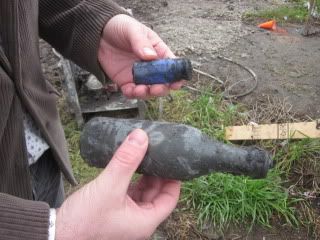
Then it happened again and this time right in front of my eyes. The giant auger came up out of the pipe, the huge corkscrew blade spun around and all the clumps of mud came flying off the blade. There was an unbroken Chas Wilson soda bottle that rolled off the clumps and a little blue Bromo Seltzer finger sized bottle was spotted in the mud beside it. They were retrieved and wiped clean.
Through the chain link
fence around the construction site, further along at the base of 'the piles' I could see broken pot lids and broken stoneware. With my sharp eyes I spotted other small cylindrical pottery vessels covered in white furnace ash. And once again as the auger came up out of the pipe I saw a cross section of a decent little dump with multiple ‘goody veins’ right there on the blades. I should have taken a video of that moment, or a picture of the booty on that huge drill bit – but I was standing right beside Shawn the Shovelman and I couldn’t very well make media in such an overt manner at that particular time.
The excavators are curious about why some bottles are worth more than others? They always ask which bottles to look out for, and if you tell them a name, any name, they'll squint their eyes and try for a moment to commit the words to memory. The older guys with good collections already know what to pick up - and it all happens so fast. The backhoe operator will pause the machine and give a nod to his shovel man when he sees something he wants. He'll get out of the machine himself and get down and pick it up if he sees blue glass, or any unbroken pottery, or any torpedo shaped glass bottles - that's money. If he gets out of the rig a lot it will annoy the site manager and the people watching the clock will soon make rules against the bottle collecting.
At Cherry St. I got the general impression that the guy running the biggest machine was in charge of the whole operation. When I handed my card to Shawn he removed his muddy gloves and carried the card with some care all the way over to the corkscrew operator. This bearded chap scrutinized my card from inside the cab of his two story drilling machine. He looked up at me in the gate. I waved. He nodded. Then I turned around and walked back to The Distillery...
At my office, I did some research on the area and found some great cartography. This very old area has changed considerably since the 1800s. This land was also the site of a large city dump – the Keating Channel is a relatively new development. Here's a map of this area in the 1870s. On this date in history, the city of Toronto is ready to expand by dumping household garbage into the marshy lake shore. (Click these map pictures, they expand.)

Look at the little river channel through the marsh south of the Grand Trunk Railway. I put the X in the wrong spot - the railway tracks are still there. The diggers are actually digging in the original mouth of the Don River!
Now here is the same property in 1910. Notice there is no sign of the Don River here whatsoever. The mouth of the river has been buried using mostly household trash and wood ash. (Click these map pictures, they expand.)

Now
here is the same property in 1941 - now there is a steel bridge over the Don River spillway, the Keating Channel (Click these map pictures, they expand.)

TWO DAYS LATER MY PHONE RANG
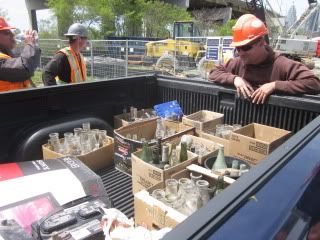
Two days later I got a phone call from the big screw driver and he asked me if I would like to come down to the site and have a peek at what he's been picking up all week. He was pretty excited about some recently recovered bottles. He wanted to sell them. ‘Listen’ the voice says, ‘I’ve got six boxes in my garage, and my wife is clean freak. I’ve got to get rid of some.' And soon enough he asks if perhaps I'd like to buy the whole lot? "Of course," I reply, 'bring everything.'
Of course I won't buy the whole works – not unless I can see squat sodas and ginger beers in the boxes, but yes, I will come and look at them and cherry pick through the boxes looking for the best bottles to buy. I'll make purchases, one at a time, haggling for the lowest possible price per item, while angling for freebies.

The following afternoon,
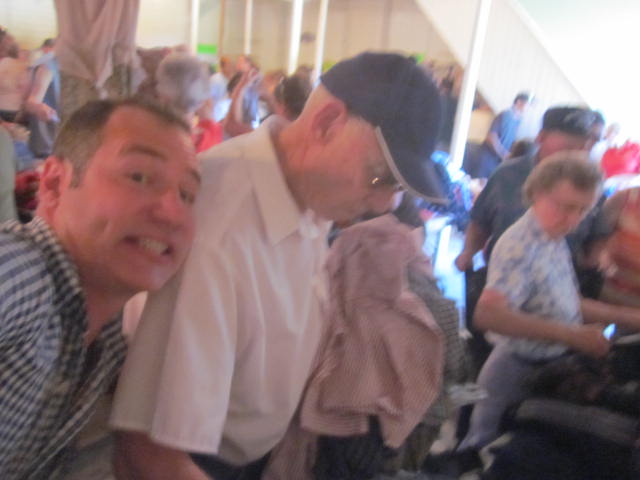
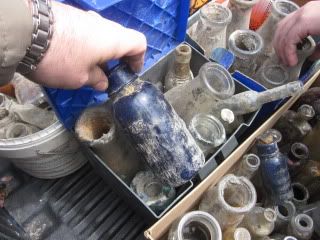
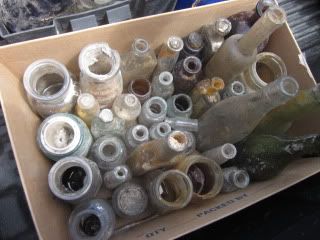
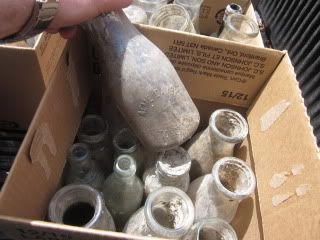
Weds May 25th 2011 I had my first experience as a construction site bottle picker. I was there waiting at the gate at 12:00 noon sharp as per our earlier arrangement. For years I’ve heard about hoarders who've made fortunes buying and selling valuable glass vessels found in excavation sites. The pieces change hands three or fours times before the end up in the city's best antique shops. But that was then, and this is now. Bottles and stoneware collectibles have plummeted in price. And the merchandise that was put on display that afternoon really wasn't all that special.
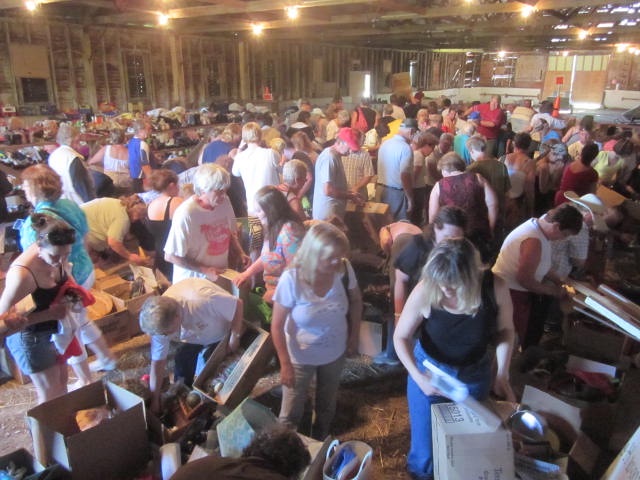
 The Excavation Site Bottle Show Started at Noon

Here's a clear class Orange Crush, and below is a Bromo Seltzer.

Found a little Balsam Honey.

Some common Toronto patent medicines,

Some common early Toronto milk bottles

and at least one bottle I'd never seen before...

Stay tuned for more information and more pictures...

 THE SECRET LOCATION: Behind the fence beside the red brick building is an empty lot. On this site, 130 years ago there was a bakery, which operated here between 1855-1865, and would have baked the bread that New Yorkers ate as they read news of Civil War battles. DS McGee writes, "Prior to the Civil War era salvage dig of this weekend, we investigated a shallow woodliner ( a latrine that had wood boards lining the interior of the shaft) which dated to about 1885-1915, and a long narrow 'trough' privy, 10 feet from end to end, 3 feet wide, and only 3 feet deep, which was constructed of stone and filled with mostly 1880s-1910s 'hutch' style beer and soda bottles." So readers come to understand that the dig team has been on this property before, and only just recently found the oldest 'well' as they call a privy (latrine).
 Over time the team sunk many test pits which are small probative holes until they encountered something, anything especially a rich deposit of historic glass - on this day they found the top of a century old well. McGee writes of this picture, 'Here is one small section of the 'privy well' open for the first time in about 130 years.' This 'well' was made of heavy stone, its circumference nearly six feet across, once emptied, from the floor to the top of the yard measured 7 1/2 feet. Click the picture, it expands and you can see they have a small privy rod - a four foot spring steel rod on which there is usually a short piece of grid pipe welded for a handle.
 The bottles came up in clutches, along other detritus. One of the first bottles discovered was this large green medicine bottle, seen here alongside a Civil War era soda or beer, a XXX Ginger Ale, and others. Manufacture date of the items ranges from about 1860-1875.
 Perhaps most spectacular is this teal green "T&M" medicine bottle, heavily embossed on both side panels, and a very pronounced 'open pontil' scar on base, c.1855. This is a fairly rare find on any salvage dig and a nice addition to any New York druggist bottle collection. Now DS Mcgee has the task of determining just who or what was T&M? and what concoction was once sold in this container?
  DR. PORTER / NEW YORK, c. 1865, seen here just as it appeared in the ground. And below are clay saloon pipes, manufactured between about 1855-1875. These are usually found without stems because the pipes were disposable in that the stem was seldom cleaned but rather broken off and shortened as it became clogged.
  Here's the final stash or what most Dumpdigging teams will 'The Picks', because at the end of the dig everyone will pick from the pile (usually after flipping a coin to see who picks first). I would take that Civil War era umbrella ink seen in the front row. Click the picture - it expands!
  In his closing remarks DS McGee writes, '...despite the intense heat and labor intensive conditions, we were able to salvage over 30 antique bottles before the backyard renovation was underway.' Good work McGee. Keep saving history and sending us the pictures.