Sunday, April 25, 2010

2010 Toronto Bottle Club Show and Sale

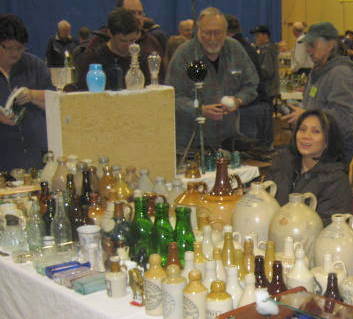
Sunday April 18th 2010 was a beautiful day for the Four Seasons Bottle Collectors club Toronto Bottle Show at the Humber College gymnasium in Rexdale Ontario. The show consists of about sixty dealers and has an attendance of over thousand people, but the room is filled with about a half million dollars worth of rare and valuable early Canadian antique bottles and glass.

Of course I wrote about the 2010 Toronto Bottle Show on Dumpdiggers.com and detailed the event, highlighting exceptional bottles, bargains and the best dealers that make it all happen. Year after year, this show gets better and better (except the bottles seem to be going down in price).

The article details ten different antique glass and pottery dealers alongside their favourite collectibles. I interviewed Tim Denton, Fred Spoelstra, Pete Bechtel, Dwight Fryer, Cliff and Donna Stunden, Kert Wrigley, Jamie McDougall, Bill Ash, Terry Matz, Richard St Onge and Bill Cook, Michael Anders, Tim Maitland, Marcus Johnson and closed the piece on Scott Wallace and Scott Jordan sitting pretty at the Maple Leaf Auctions table.

The article also chronicles my day's traveling companion, Kelly Gadzala the Toronto Grunge Queen blogger who specializes in writing about finding vintage collectibles, clothing and keepsakes.


The Toronto Bottle Show is always an emotional experience for me - it breaks my heart to see great pieces of glass selling for ten or twelve dollars, and whenever I spot something that I have in my own collection I almost don't even want to look at the price, as I'm sure it will always be priced to move here and cost much less than I paid, or had valued in my own head. I think it would be worthwhile to visit this show and spend forty thousand dollars buying the best pieces - it would be a great investment in the future.

Monday, April 12, 2010

Maple Syrup Antiques at Sandy Flats Sugar Bush

Maple has a season. The Ojibwa people knew this period of the year was special, and they called this moon phase the "sugaring off" period, or the "maple moon" or "sugar month". The tradition of sugaring off became established in communities in the deciduous forests of North America, and has survived to the present time.

On Saturday April 9th 2010, Dumpdiggers visited the Sandy Flats Sugar Bush in Warkworth Ontario.

with Hugh and Lorene Campbell, the local beekeepers / honey producers. Campbell’s Honey house is located less than 3Km away from this sugar bush, between Roseneath and Warkworth. It’s a delicious coincidence because maple syrup is a pure, natural sweetener, the only other liquid natural sweetener being honey. But unlike honey, maple syrup has more trace minerals essential to good nutrition: potassium, magnesium, phosphorus, manganese, iron, zinc, copper and tin, as well as calcium are found in concentrations 15x higher than honey. And its important to note that maple syrup contains only one-tenth as much sodium as honey.

It’s a little known fact that the manufacture of maple sugar is limited to the Maple Belt, the hardwood forest stretching from the midwestern US through Ontario, Québec and New England and into the Canadian Maritimes.

Relics of the Maple Sugar Industry at Sandy Flats Sugar Bush
Hanging on the wall of the pancake restaurant at the Sandy Flats Sugar Bush is a world class display of vintage Canadian maple sugar industry antiques. I briefly paused to admire and photograph the collection of vintage tools, and equipment, including some very valuable hand carved wooden maple sugar molds.


Maple products are harvested exclusively from the sugar maple (Acer saccharum) was known and valued by the native peoples of eastern North America long before the arrival of European settlers.


An Iroquois legend tells of the piercing of the bark of a maple and the use of the "sweet water" to cook venison, a happy accident which established the culinary tradition of maple-cured meats.

French settlers probably learned from the Indians how to tap trees to obtain sap and how to boil it to reduce it to sweet syrup or sugar slabs to be stored for later use.


George Potter’s family diary records his great great grandmother’s sap spile as being a simple cedar splint, in keeping with native practices. Here is a reprinting of the material I found on the wall.

From the diary of my great, great grandmother, Mary Mac Kenzie Ross, 1840.
“John was busy clearing around our cabin, getting a plot ready to spade for potatoes in the spring. A neighbor noticed he had several short cuts of cedar logs. ‘Mr. Ross’, said he, ‘you want to lay those aside and in the winter make sap troughs and spiles ready for the run of sap in the spring.’ Then he told him how to make maple syrup. We were quite taken back there was so much work about it, because in Scotland they thought maple trees ran syrup when they were tapped. However, we borrowed an iron kettle and tapped the maple trees in the spring, boiling the sap outside, although it was dark and smoky tasting. We thought it was a treat.”
George Potter


Other Writings on the Wall at Sandy Flats Sugar Bush
History of the Sandy Flat Sugar Bush

George, growing up as a young boy helped his father collecting and boiling syrup, so when the Potter’s first bought the property tapping the trees was just a hobby. Alice working as a schoolteacher and George owning a men’s clothing store downtown Warkworth. They began with 50 taps, 200 taps then progressed to more than 500.
What started as a hobby soon became a business as Alice and George found themselves running sap all through the night. Alice and George made a decision to retire from their current jobs and commit themselves to the Sugar Bush. As a result of their decision they began to upgrade their equipment. They soon installed a modern pipeline system to transport the sap, this meant more taps (5500), more sap. With all this extra sap a larger evaporator was needed. Today they operate 2 wood-fired evaporators and use a reverse osmosis (nicknamed R.O.) method of making maple syrup. Soon not only were they making maple syrup but maple butter, maple stirred sugar and other syrup products. All of their products are 100% pure. In 1987 the Potter’s began entering their syrup in local fairs winning ribbon after ribbon, but the local fairs were just a guideline to the larger fairs. It proved to be worth their time as it led them to winning a 4 World Championships at the Royal Agricultural Winter Fair, Toronto, Ontario in 1988, 1990, 1993 and 1994. Just a couple weeks ago the Potter’s were inducted in the Maple Hall of Fame in the Ameliasburgh Maple Museum.


History of the Land
Over the years the tree’s on the Potter’s land have been tapped off and on since the mid 1800’s. The first owner of the Sandy Flat Sugar Bush was William R. Losie who first began tapping the maples. The Miner Family, the next owners also tapped the tree’s as well as the third owners, The Milford McVety Family who continued tapping until 1968. The bush laid dormant until George and Alice Potter started making syrup in the early 1970’s.

The History of the Maple Syrup Festival

Originally when the Sandy Flat Sugar Bush became a business they had an “Open House” policy were people were invited to come as they please, tour the grounds and enjoy a traditional maple breakfast. A few years later in 1985 the Kinsman Club decided to get involved by hosting a weekend where club members would cook outdoors for visitors who attended the event. While at the Bush you can enjoy a old fashioned horse drawn sleigh ride, taffy on the snow, compare the native, pioneer and modern methods of gathering and processing sap, educational nature trails, join the log sawing contest, and listen and watch the old thyme square dancing and Potter Band. In 1987 the service club got involved by also hosting a weekend during March. Soon there were many more people wanting to contribute their interests and include the community. The 55 Plus club started organizing other events and a Maple Syrup Festival Committee was begun. Mary Hermiston as Treasurer, Vic Taylor and Jim Horne lad a service club committee. The Percy Quilters displaying a variety of finished pieces in the Town Hall, also a newly finished quilt is raffled off on the Sunday afternoon. Wood, works and wonders is another attraction you will find at the Town Hall where there is a display of handcrafted wood products for sale. Just beside the Town Hall you will find a petting zoo and pony rides. You can visit the antique show and sale at the Percy Centennial School where local antique dealers have brought together an extensive display of treasures from the past. An art show displayed at the Heritage Centre organized by the Northumberland Hills Art Association where local artists have come together for the show. On the festival weekend approximately 8,000-10,000 people traveling from all over.


Some Basic Facts about the Modern Maple Sugar Industry
From the Canadian Encyclopedia’s page on the Maple Sugar Industry, I learned that there are currently over 16 000 maple-syrup producers in North America, with over 80% in Canada. In 1995 total world production was 18 981 kl, of which Canada produced 14 890 kl. The province of Québec produced 13 540 kl, which represents over 90% of the total Canadian production. The rest of the Canadian production came from Ontario (5%), New Brunswick (4%) and Nova Scotia (1%).
In the early part of the 1970s, the traditional buyers were the large food companies. When the US Food and Drug Administration reduced the minimum volume of maple syrup that must be listed as an ingredient in products sold as "maple syrup" and "maple sugar" from 15% to 2%, sales plunged dramatically and the industry experienced a major crisis. Efforts were made to develop a new market aimed directly at the consumer and the growth of this market has rejuvenated the industry. Maple products are now consumed in over 30 countries. Maple syrup remains one of the best natural sweetening sources in the world. It is still served mainly over pancakes, but recently it has also been considered a condiment. It is now used in fine cuisine to prepare sauces, glazes and vinaigrettes. In addition to its use as a syrup or as an ingredient in fine cuisine, and capitalizing on its magic and mystery, some consumers around the World prepare concoctions for special diets or for purification purposes or during special events such as fasting.

Its clear that by the crowds at the facility that day that family operated sugar shanties, which are so evocative of Canada's pioneer past, will remain a thriving part of the rural Canadian landscape . In the future, Dumpdiggers believes that Canadian maple syrup industry will grow and prosper in as a natural sweetner. Much like single variety honey has found tremendous support in cuisine arts, maple sugar will rise in value in the modern food industry, and become the preferred sweetner of the world's finest palates.

Tuesday, January 12, 2010

Abel DaSilva Buys And Sells Antiques in Downtown Toronto

Abel DaSilva outside the St Lawrence Sunday Market in Toronto, told Dumpdiggers that the only he time he doesn't make money shopping for antiques is when he doesn't buy anything. A bold statement, and we loved it. And from that moment forward, on Sunday January 3rd I personally watched the man like a hawk, determined to learn the secrets of his success.

Just after the holidays, I wrote and published two stories about an afternoon that I spent with Abel DaSilva, Toronto’s foremost antique glass bottle merchant and quite knowledgeable in multiple subjects. He's an eBay power seller, and a prolific Yahoo Groups discussion forum participant.

Shopping for Antiques at the Sunday Market in Toronto with Abel DaSilva is a first person account of what I saw while following Abel around the St Lawrence Hall as he sniffed and pawed hundreds of collectibles. This article establishes the setting and chronicles the purchases of a wise man leveraging his knowledge of history. Abel understands tricky niche markets for collectibles and how to buy local and sell global using eBay and related Yahoo antiques collecting groups.

Another article, perhaps even more fascinating, is entitled Sightseeing with Abel DaSilva in Downtown Toronto, and this matter sifts through half a dozen stories about four different building lots in the downtown core. In each of these urban properties there were truckloads of historically significant antique glass bottles discovered by professional excavators with no mandate to preserve or even document their finds. What happened to this stuff? Abel knows the whereabouts of almost all the buried booty, and has stories about what's still under just about every new structure on the Toronto shoreline.

What’s even better is how Abel befriends the excavation company employees, site supervisors and heavy machinery operators by sharing his knowledge of the specimens they unearth in their digging projects. Abel doesn't have much time between when the men and machines start excavating, and when the pile drivers start pounding, and the first concrete teams arrive to pour cement in insulated concrete forms for walls and floors, and reinforced pillars for the parking garages. Mr DaSilva gets their attention two ways. He makes them take time out of their busy schedules because 1) he's very generous about sharing tips, and heritage information about the site and its contents, and 2) he has a fistful of ready cash. Click the pictures they expand - look carefully at the picture above right, and you can see hundred year old glass bottles in the ashes behind the bulldozer.

Wednesday, December 2, 2009

New York City Bottle Diggers Strike Beauty in Night Soil Story


Last Sunday, Dumpdiggers got an email from an Ole friend in New York City boasting about conducting a clandestine archeological dig in one of the most densely populated places on planet Earth. The Manhattan Well Diggers are tireless explorers and this story highlights their abilities and imaginations.

The author is a dedicated digger that waxes poetic about his trips twenty feet down in the depths of his hometown. New York City has some of America’s most historically fascinating suburbs and the trinkets, bottles, jars and crocks and porcelain potlids that these guys dredge up makes all Dumpdiggers suddenly snap to attention .

In this particular story, Dan and his team dig a deep hole behind a renovated townhouse and there go back in time to recover these wonderful objects. With that same trusty blue shovel Dan and his team recover various pontiled items from the 1850s and early 1860s including an eight sided desk ink: HARRISON'S / COLUMBIAN / INK and a CLIREHUGH'S / TRICOPHEROUS / FOR THE HAIR & SKIN / NEW YORK. Also uncovered was a brown and white potlid with an eagle at the center atop a shield baring stars and stripes, CHLORINE DETERGENT & ORRIS DENTIFICE / FOR / CLEANSING & PRESERVING / THE / TEETH / PREPARED BY / ROYCE & ESTERLY / DENTAL SURGEONS. Soon after we discovered a BARKER'S / CHEVEUX TONIQUE / FOR THE HAIR / BDWAY N. Y

Dan starts his latest adventure by telling readers some historical facts like how in 1851 the Hudson River Railroad opened a station at West 30th Street and how business flourished as breweries and soda-water factories, malt houses, stone cutting yards, large stables and slaughter houses, lumber and coal yards, grew up around the tracks etc. The housing was notably inferior as it was hastily erected to accommodate newly arrived immigrants. The narrow houses and wooden buildings sprang up overnight, sometimes right alongside stretches of stylish brick townhouses (which is what they were digging). In the 1850s and 60s, downtown Manhattan is reported to have contained approx 20,000 structures, mostly small or mid-sized factories and sweatshops.

The fire insurance maps show few of the savory little details however, and do not differentiate between style or function of the buildings beyond showing churches, and hotels. The only way to learn what actual living conditions existed from place to place is to dig.

The nicest piece recovered, in my opinion, is this beautiful teakettle ink circa 1860-65, in mint condition. When positioned in direct sunlight it produces a marvelous deep purple colour. It’s made of dark violet or black-amethyst glass, possibly of English or French origin. Dan describes how it was ferreted out from near the privy floor, and remarks on how the exact likeness has never been seen before (by him).


In all there were nine pontiled aqua medicines with raised lettering, mostly cosmetics for the hair and skin, an umbrella ink, and others. Additionally, another potlid and matching base, one clay pipe, one ivory toothbrush handle, a small quantity of common food bones, and an assortment of fruit and vegetable seeds sprinkled therein. Also discovered was a Barker's Cheveux Tonic; DR D. JAYNE'S / HAIR TONIC / PHILADA; BOGLE'S / HYPERION FLUID / FOR THE HAR; HURD'S / HAIR RESTORER; PHALON & SON / PERFUMERS, N. Y.; DR. D. C. KELLINGER / N. Y; ROUSSEL'S / UNRIVALED / PREMIUM / SHAVING CREAM… / X. BAZIN. / 114 Chestnut St / PHILADELPHIA. The earlier base reads GOLD MEDALS AWARDED / E. ROUSSEL / 114 Chestnut St / PHILADA / PERFUMER

Vist ManhattenWellDiggers.com to read the rest of Night Soil.

Saturday, September 26, 2009

Elfshot: Sticks and Stones, an Archeology Blog on Canada Blog Friends


Tim Rast writes Elfshot: Sticks and Stones, which is an archeology blog centered on his life and work in St Johns, Newfoundland. Tim is a modern day flintknapper and his domain is profiled this week on Canada Blog Friends.

A flintknapper is someone who makes stone arrowheads, and Tim specializes in recreating the authentic points used by the Maritime Archaic Indians, the Groswater and Dorset Palaeoeskimo and the Newfoundland Recent Indians.

"Knapping" is the shaping of flint, chert, obsidian or other stone through the process of lithic reduction to manufacture stone tools, strikers for flintlock firearms, or to produce flat-faced stones for building or facing walls, and flushwork decoration.

Dumpdiggers everywhere could learn a thing or two about Flintknapping by reading Tim's blog. He makes it fun and easy because his writing is terrific. Start with this piece about Dorset Palaeoeskimo knives because it’s a pretty good little snapshot of what the site is, and what Elfshot is all about. It brings archaeology, arts and crafts, and geothermal energy in the high Arctic all together, with a pinch of polar bears.

Tim Rast describes his experiments patinating copper as a fun bit of household chemistry that’s useful for the sort of artifact reproduction work that he does.

Dumpdiggers might also find Tim's first post about the Tuktut Nogait bow that he's working on for Parks Canada to be quite interesting, but the Ioffe Site post is really outstanding. In this piece he describes a site that he found while working as a resource archaeologist for an Adventure Canada cruise last fall.

Tim Rast is Canadian, from Alberta. He has two university degrees including a Masters in Anthropology from Memorial University in Newfoundland. He's a terrific writer, researcher and blogger, and a bright light in the darkness that surrounds the study of the earliest Canadian people.

Sunday, September 13, 2009

Passion for the Past Antiques in Toronto

The writing is on the chalkboard out front of Passion for the Past antiques store at 1646 Queen St West (Queen and Roncesvalles) in downtown Toronto, Ontario.

For ten years now the shop at the top of the hill has been selling fine china, dishware, glass, furniture and jewelry to the people of Toronto. But now the portal is closing.

Passion for the Past goes online!

Joe is going to sell online and reduce his expenses by about 90%. And he doesnt need Smojoe to tell him that selling online is an entirely different business. It requires promotions and online storytelling, and the love and respect of editors, bloggers and discussion forum moderators.

Here's Joe with a prized LORRAINE GLASS CO. MONTREAL, QUEBEC, CANADIAN HAND BLOWN RED GLASS CENTERPIECE, 27” LONG X 10” WIDE X 10” HIGH, CIRCA 1962-1974 this gorgeous piece of art glass is a good example of what Joe loves to sell at his bricks and mortar store and now online.

The hand drawn signs out front of the venue have the look of frustration and desperation in their manner - 70% off is hard to ignore in any font. And that's what brought me into the store. Once inside I met Joe Clement and his mother and was carried away by their friendly manner and entertaining conversation. Joe has the slight trace of an East Coast accent, but complains that its from working with John and his diction should be French.

Joseph Clement is partners with John Hogan, whom I’d met before when I was in there earlier in the summer. Joe was new to me. He made me laugh when I asked him about certain things and their cultural values? His rather dismissive remarks told me that he worships antiques on an entirely higher level than us Dumpdiggers; perhaps he places craftsmanship above historic value. "Put it this way," he says "If this place were on fire I would waste my time grabbing anything from that case."


2] ANCHOR HOCKING GLASS CO., VINTAGE FIRE KING GLASS MIXING BOWL, 8 1/2" DIAMETER X 5 1/4” DEPTH/HEIGHT, CIRCA 1950-1960

Sadly I didn't get a decent picture of Joe's MIDDLESEX FURNITURE COMPANY ANTIQUE MAHOGANY CHINA CABINET.

See anything you like? Contact Passion for the Past as follows,

John Hogan or Joe Clement
Passion For The Past Antiques
1646 Queen Street West,
Toronto, Ontario,
Canada
M6R 1B2

Phone: (416) 535-3883
Email: infoATpassionforthepastantiquesDOTcom

Store Hours:
Tuesday-Sunday:11:00 AM to 6:00 PM;
Monday: Closed

Here's a Mustache Cup from Germany.


Directions:
1 1/2 blocks East of Roncesvalles Ave. and Queen St. West intersection, between Callender St. and Triller Ave.

Sunday, August 30, 2009

The Canadiana Guidebook by William Philip Wilson

Among the many research tools that I treasure as much as my treasures, is a small paperback book published in 1974 by Greey de Pencier Publications in Toronto called The Canadiana Guidebook and subtitled Antique Collecting in Ontario.

The author, William Phillip Wilson notes in the introduction that Canada is still a young country and is just beginning to understand its heritage. His work sets about identifying all things 'Canadiana' with an eye on buying and collecting antiques as investments. His guidebook comes complete with maps to all the most prominent antiques hotspots in the province (in 1974) of Ontario and pages full of helpful tips, terms and references.

Indeed the Table of Contents sets forth the dimensions of his categorization and includes Furniture, Treen, Iron, tin, brass and copper, Silver, Pewter, Ceramics, Glass, Textiles, prints, painting and framing, and also includes lists of stores, and maps of Upper Canada.

Types of wood furniture are first assembled by making a distinction between softwoods and hardwoods. Mr Wilson teaches how to recognize Maple furniture from Birch, and the unique characteristics of Butternut, Oak, Chestnut and Cherry. He quotes Thomas Ormsbee'a Field Guide To Early American Furniture (Boston: Little, 1951), when he writes on how to spot Hepplewhite armchairs and 'chicken coop' Windsor side chairs in so much clutter at local antiques shops or mismatched, painted and stacked on tables at antiques auctions. Now I want to own a Schrank or clothes cupboard from the 1830s someday...

Treen is an old word. In the same way ‘wooden’ means made from wood, the word ‘treen’ is the old English word that means the object was made from a tree. Hardwood was most often used for treen objects, especially kitchen utensils. Maple was most popular and birch next. Treen objects include splint boxes, bowls, butter moulds, rolling pins, scoops and mashers and the most coveted pieces, and therefore most often faked items to genuine 1800’s Quebec maple sugar moulds.

Iron is broken into two categories, cast and wrought iron and he shows pictures of commonly faked cast iron items. On page 58 I found a sketch of the Naughty Nellie bootjack which I'd once read about elsewhere and heard mentioned in other texts. Commonly found iron Canadiana includes things like vegetable choppers, cast iron ‘T.Eaton’ trivets, corking forks, and cruise (grease lamps), tobacco cutters and coffee grinders and the big ticket items are cast iron parlor stoves, cauldrons, vats, baking pots and tea kettles.

Tin doesn't mean 100% tin as the word is commonly applied to sheet iron objects with a protective tin coating in the lexicon of Canadiana. There were many generations of whitsmiths or tinsmiths in both upper and lower Canada and the most outstanding Canadian tinsmithing is exhibited in weathervanes which are eagerly sought by all Canadiana collectors. The chanteclair or ‘crow cock’ from Quebec is most obvious weathervane, but other variations like banners and horses, fish, cattle and beavers exist. Tole or toleware is another popular field inside this category – the word means tin in French and came into the English language in the mid 1800s to designate tin that has been painted or decorated to distinguish it from other more utilitarian items. Common toleware items would include spice boxes, serving trays, document boxes, and chambersticks (a candle stick with wax moat made ‘for the chamber’).

Brass and copper Mr Wilson mentions a Toronto coppersmith named H.Piper and Brothers as being a prolific mid to late 1800’s Toronto based producer of brass and copper items. Items to look for include decorative candlesticks, brass coal scuttles and cauldrons and most specifically copper tea kettles and brass pots esp a ‘jelly pan’ or kettle that was developed in 1851 made of thinner ‘lathe spun’ brass that allowed jellies to simmer properly on wood stoves. Lastly look for chamber sticks and pierced candle lanterns. William Philip Wilson cautions against buying ‘horse brass’ pieces, that’s what the industry calls the brass decorations that have been harvested from old saddles, because these pieces are the most commonly faked brass items as the age and authenticity of such objects is very difficult to determine.

Books detailing the trade in period iron, tin brass and copper that Phillip referenced include Seymour Lindsay Iron and Brass Implements of the English and American House 1964, and Mary Earl Gould Antique Tin and Toleware 1957, and thirdly he referenced Louise K Lantz Old American Kitchenware 1971 which he says has lots of tin and cast iron pieces illustrated and lastly Margaret Coffin American Country Tinware covers American painted tin authoritatively.

Pewter and Britannia Metal are described next on pg 76. Pewter is an alloy or mixture of metals with tin as its base metal. According to the intended purpose lead, copper, antimony or bismuth, and more often a combination of all three metals were mixed with tin to make pewter.

The finest pewter contains no lead at all and was used for dinner plates, tankards, and cutlery – the cheapest pewter may contain as much as 25% lead and this of course was the subject of much medical inquiry in the late 1800’s after England adopted laws to restrict lead in household utensils. No such law was enacted in Canada, but very little is known about Canadian pewterers. Unlike European productions which had makers marks and sometimes quality stamps, Canadian pieces were often sold unmarked. But there are some exceptions and these include the flying angel mark of Jean Menut and the beaver mark of Thomas Menut, both of Montreal.

Ceramics is broken into three sub chapters, the first being Earthenware. William Philip Wilson defines this as ‘made from local clay’ that turns a buff or red colour in the kiln at temperatures between 1200 and 1500 degrees F. From the earliest days of settlement, earthenware potters in Upper Canada were influenced by three traditions, French, English and Pennsylvania German. Wilson details how the manufacture of earthenware was often a family industry and could be done by farmers at home in the winter months.

Stoneware is made with a high-firing clay (2000 to 2200 F) that was not discovered in Canada until around 1910. Consequently all 19th Century Canadian potteries arranged for the delivery of this particular type of clay from pits in New Jersey. The importation of clay and the more complicated manufacture of kilns and facilities meant that stoneware manufacture required a factory of sorts and had to be run more as a business. Because stoneware contains silica, or natural glass, it vitrifies or bonds together when fired and as a result it does not need a glaze or seal. Typical shapes in salt glazed stoneware include jugs, storage crocks and bottles. Lean glazed stoneware is something else and when its presented with brown slip over yellow the glaze is called Benningtonware in the USA and Rockingham in Canada. The chapter concludes opposite illustrations of common makers marks used by the St Johns Stone Chinaware Company, St John’s, Quebec, 1873-93.

William Philip Wilson's favourite books on Canadian potteries includes my own favourite book by Donald Webster, Early Canadian Pottery which Wilson deems essential, and Elizabeth Collards 19th Century Pottery and Porcelain in Canada Montreal 1967 which he says is very well researched. And the author tips his hat to R.W Finlayson Portneuf Pottery and Other Early Wares, Don Mills Ontario, Longman, 1972. This book is a wealth of information that’s both a good analysis of Portneuf and many other transfer prints and imports.

Finally, after a great chapter on glass which I'll save for another post, and some insight into fine art and framed paintings, and some description of Canadiana painting frames themselves, William Philip Wilson leaves readers with maps to his favourite antiques hunting grounds in Southern Ontario Canada.